By Juan Daniel Correa Salazar
Director of Energía Limpia / Clean Energy Planet
The Biomimicry Institute chose the exact moment of the equinox to remind us of something essential: the Earth is alive, and it breathes with us.
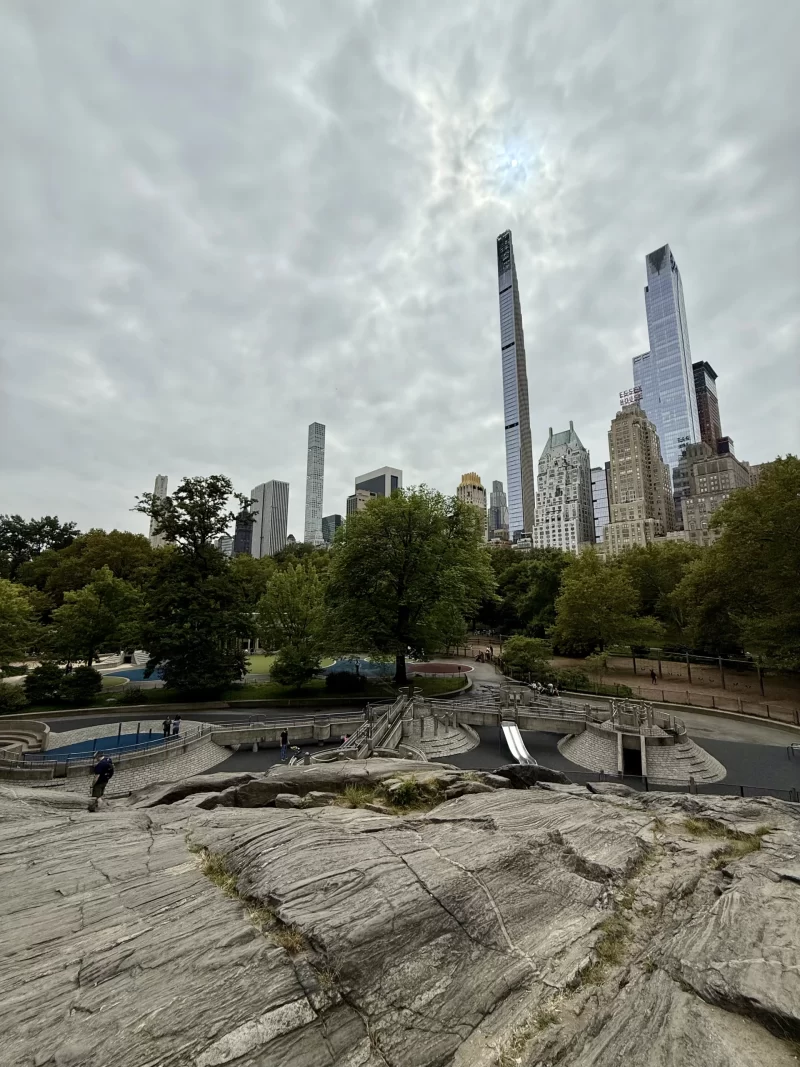
On September 22, at 2:19 p.m., the sun crossed the celestial equator, balancing light and shadow. In Central Park, atop an ancient rock called Umpire Rock, a small group gathered to receive that cosmic instant in silence — guided by a powerful idea: climate action also begins with contemplation.
Thus was born Grounding Climate Week: A Biomimicry Equinox Gathering, an experience created by the Biomimicry Institute during Climate Week NYC 2025, inviting participants to start the most important week for climate action not with haste, but with pause — reconnecting with nature and with themselves.
The Power of Balance
The equinox happens only twice a year — when the planet tilts toward neither hemisphere and day and night last exactly the same. That natural balance became the thread of the gathering.
While Manhattan buzzed with conferences and meetings, in the heart of the park a different kind of conversation was taking place — an exchange between science, history, and life, where silence meant more than words.
Dr. Eric Sanderson, Vice President for Urban Conservation at the New York Botanical Garden, shared the deep history of the site. He described how this area — now covered with trails and trees — was once a mosaic of forests and wetlands that hosted deer, bears, and migratory birds.
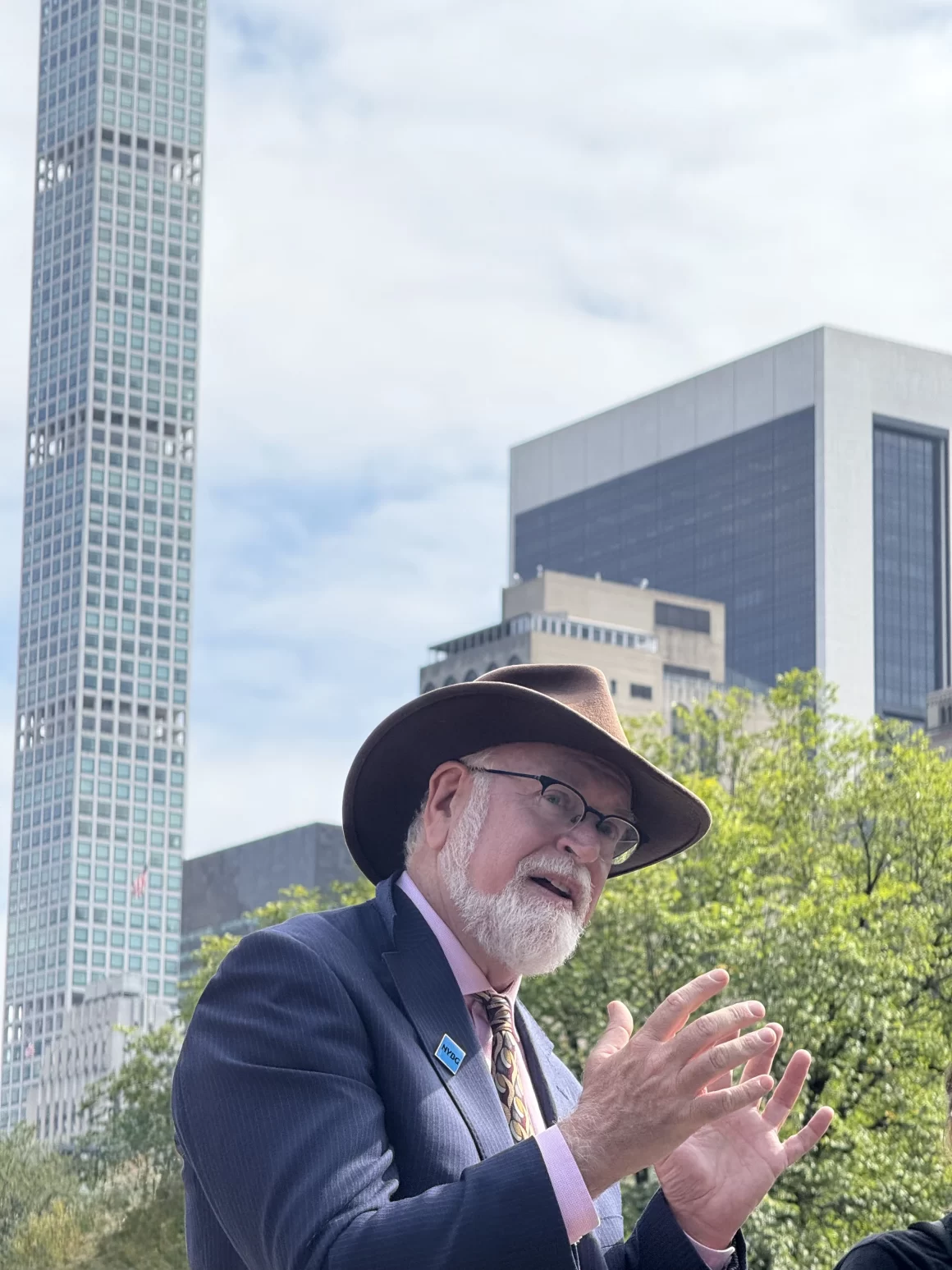
Dr. Eric Sanderson, Vice President for Urban Conservation at the New York Botanical Garden, during his talk at Grounding Climate Week: A Biomimicry Equinox Gathering. From atop Umpire Rock, he revealed how Manhattan’s deep landscape still holds the living memory of the nature that once shaped it.
The rock on which we stood, Umpire Rock, is more than 450 million years old — a fragment of a world still forming, when the continents were adrift.
Understanding that was an act of humility: nature has sustained life long before us, and it will continue long after.
Then Andrew Howley, Chief Editor at the Biomimicry Institute, guided the group inward: “Before trying to fix the world,” he said, “we have to learn to listen to it.”
And so we did. For a few minutes, the group fell silent. The wind, the birds, the texture of the stone, and the pulse of the city merged into a single rhythm — balance made tangible.
Biomimicry: Learning from Life to Sustain Life
Biomimicry — from the Greek bios (life) and mimesis (imitation) — is the practice of observing nature’s strategies to design human solutions.
For over two decades, the Biomimicry Institute, led by Amanda Sturgeon, has advanced this interdisciplinary approach that unites science, design, ethics, and purpose.
Termite mounds inspire naturally ventilated buildings. Leaves teach us how to capture light efficiently. Coral reefs reveal how cooperation strengthens structure. Each organism and ecosystem holds a principle that can guide us toward a more balanced future.
But beyond technique, biomimicry proposes a cultural shift: to stop seeing nature as a resource and start seeing it as a teacher.
Technology That Learns to Listen
Days after the equinox, the Biomimicry Institute unveiled in New York a new initiative that extends this philosophy even further: AskNature: Solutions from Life.
It’s an open platform — asknature.org — gathering thousands of examples of life-inspired innovation, from how plants filter water to how bat wings optimize flight.
Within this platform, the Institute developed AskNature Chat, a tool powered by ChatGPT, that literally lets anyone ask nature how to solve a human challenge.
Through this interactive experience, artificial intelligence acts as a bridge between human curiosity and billions of years of biological wisdom.
The paradox is beautiful: cutting-edge technology learning from ancient intelligence.
True innovation isn’t about surpassing nature — it’s about understanding how she has sustained life for 3.8 billion years.
The Inner Equinox
Nearly two months have passed since that afternoon. Writing now, with distance, helps me understand the depth of what we lived.
The event was brief, yet its echo endures.
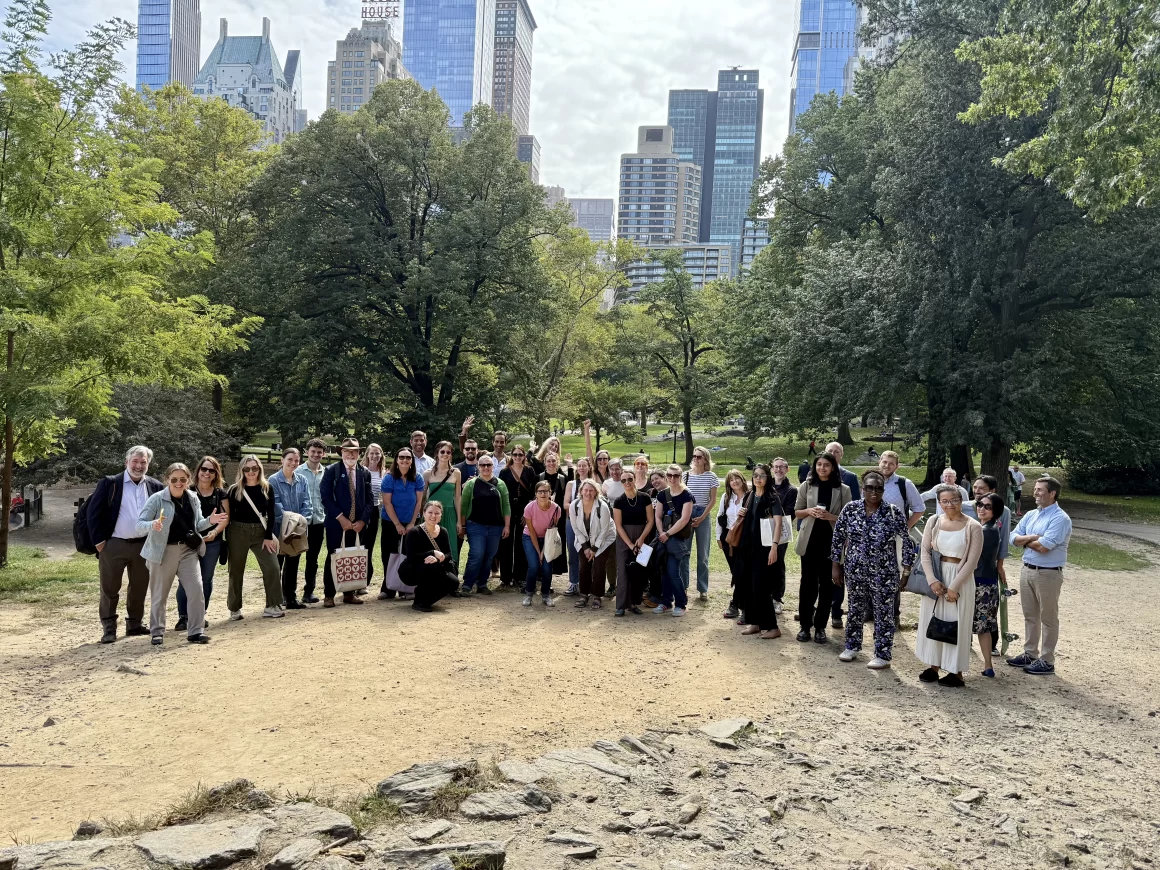
Delegates from diverse regions and disciplines gathered in Central Park to share a moment of reflection and connection with the Earth during Climate Week NYC 2025.
At 47, I also feel that point of balance — my personal equinox.
I’ve spent my life communicating, creating, and connecting, but that day I realized sustainability isn’t only practiced outwardly — it’s also within: in how we breathe, walk, and observe.
Some participants removed their shoes and walked barefoot across the grass.
I recorded a short video and took a few photos, as both journalist and witness — not to document an event, but to preserve a feeling: the moment when our breathing fell back into rhythm with the planet’s.
The images that accompany this article reflect that quiet harmony between action and contemplation — between what we do and what we feel when, for an instant, the planet and humanity share the same pulse.
Bridges Between North and South
While the North paused to listen, the South prepares to host COP30, set to take place in the Amazon. Between both hemispheres stretches an invisible thread that knows no borders: life itself.
From Bogotá, another great city that breathes among mountains, I write surrounded by a diversity that is not only biological but also cultural and spiritual.
Colombia, one of the most biodiverse countries on Earth, remains a place where science and nature still converse — where knowledge mingles with intuition and memory.
That is why this article is also an open invitation to the Biomimicry Institute and to all who seek inspiration from the Earth: look to the South.
Here, every river, forest, and high Andean páramo holds living answers — lessons not extracted but shared.
In these latitudes, nature still speaks in the present tense. We just need to listen.
Durabilité: What Endures
In French, sustainability is durabilité — a word that evokes permanence, patience, and balance.
I first heard it in Paris during Change Now, and since then, I haven’t stopped thinking about the paradox it carries: change now, yes, but with eyes set on what lasts.
The equinox lasted only a moment, yet its message persists.
True change isn’t imposed; it’s cultivated.
And that’s where everything converges — in realizing that sustainability is long-term, that it unfolds over time and only flourishes when we think beyond the immediate, even though it always begins today.
From this megadiverse land, where life blossoms daily, writing about sustainability is an act of gratitude — gratitude to the Earth that sustains us, to the science that observes, and to the communities that still live in harmony with nature.
Like Umpire Rock, which has witnessed millions of seasons, durabilité reminds us that all true change needs time, roots, and memory.
The Oldest Lesson
Nature precedes us, teaches us, and will outlast us. And still, she remains willing to show us the way.
She teaches us to regenerate without exhausting, to adapt without destroying — to understand that balance is not a destination but a way of belonging to the world.
The true challenge for our species is not to conquer the Earth, but to belong to her again — to remember that we are part of her, not her owners.
That, in the end, was the message of the equinox: that even in the heart of a city like New York, it is still possible to stop, touch the ground, and listen to the planet’s pulse.
And when that happens — when our breathing once again matches the Earth’s — something deeper than a revolution begins: the reunion of humanity with life.
🎥 Watch the video of Grounding Climate Week: A Biomimicry Equinox Gathering:
Images and footage by Energía Limpia / Juan Daniel Correa
Sources and Related Links:
- Biomimicry Institute: https://biomimicry.org
- Grounding Climate Week: https://biomimicry.org/events/grounding-climate-week-a-biomimicry-equinox-gathering
- AskNature: https://asknature.org
- Climate Week NYC: https://www.climateweeknyc.org
- Change Now: https://www.changenow.world/
- COP30 – Belém do Pará, Brasil: https://cop30.br
- Clean Energy / Energía Limpia: https://cleanenergyplanet.org