By Juan Daniel Correa Salazar
Energía Limpia / Clean Energy
Belém was never just another venue. From the moment it was announced that COP30 would take place in the Amazon, it became clear that this time the territory itself would define the conversation. Not because the rainforest is a convenient symbol, but because it has a unique way of reminding us what matters. The Amazon does not speak in speeches: it speaks in vapor, in water, in roots, in that deep pulse that sustains life without needing a single word. There, nature expressed itself through facts, not slogans. It showed its quiet strength, its internal order, its clarity.
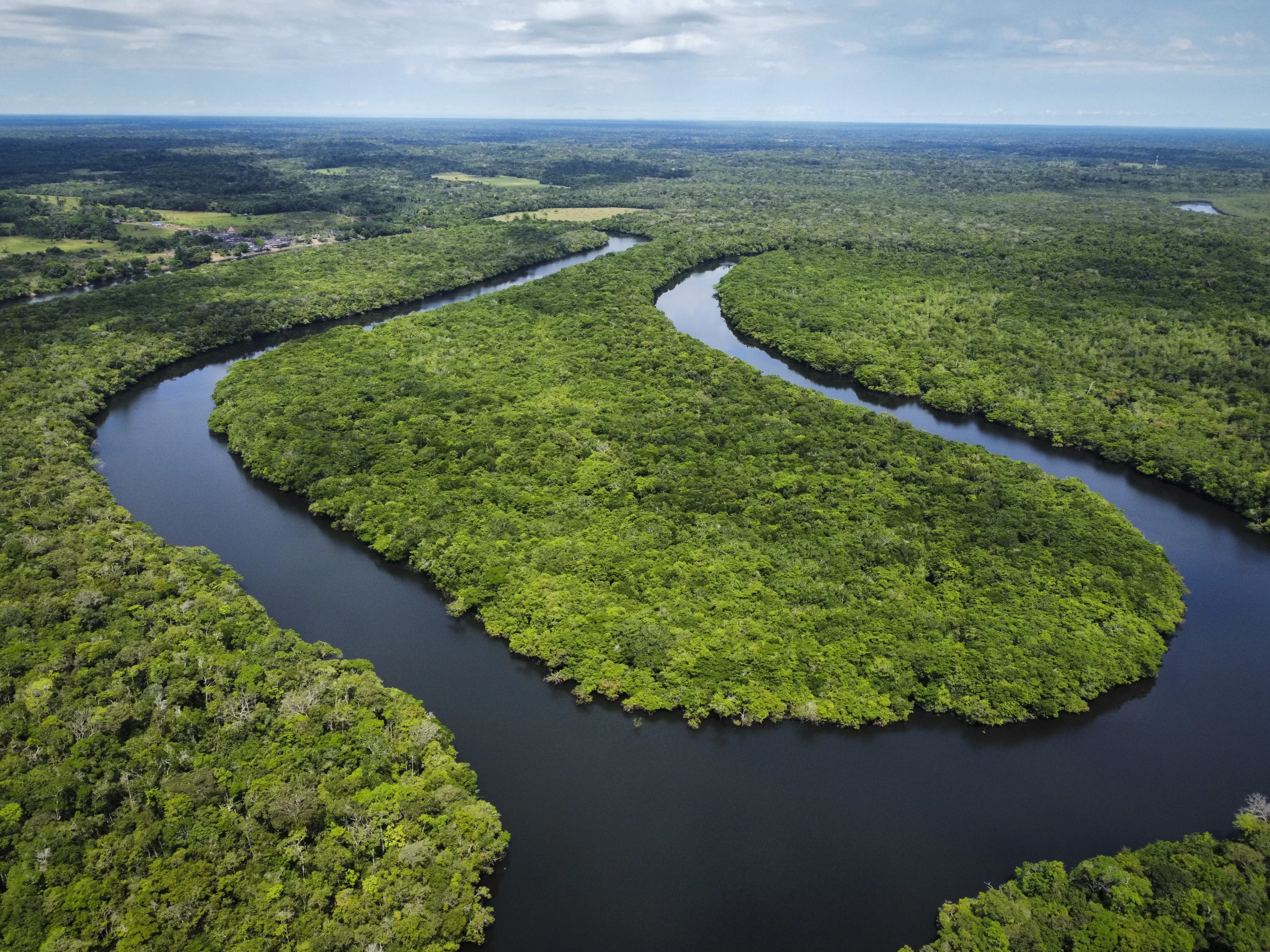
The images that accompany this piece —captured by photographer Niko Jacob in the Colombian Amazon and Guaviare— are also testimonies of that clarity: children growing between leaves and rivers, primates watching in silence, macaws cutting through the air, territories breathing with the same precision with which our decisions should breathe.
The world, meanwhile, responded with noise. Noise made of rigid positions, political calculus, fossil interests adept at operating through confusion, activists who confuse urgency with shrillness, and governments trapped inside their own narratives. While the forest kept a steady rhythm, humanity insisted on being out of tune.
1. Belém Wanted Balance, Not Lounge-Room Heroics
A COP in the Amazon does not need theatrics. The forest does not demand fanaticism nor does it offer prefabricated heroism. It simply reminds us that sustainability is a continuous task of adaptation, cooperation and responsibility. The transition is not a shout —it is architecture. It is not a revelation —it is a conversation between science, territory, culture and economy.
Belém offered that space. Yet what surfaced were speeches crafted more to impress than to build.

In the rainforest, even a single glance is enough to understand what matters. This squirrel monkey, watching from a branch on Isla Arara, reminds us that the territory observes, learns and endures without speeches. Its presence is a simple and profound lesson: nature does not seek an audience, it seeks continuity.
2. The Arsonists of the Narrative: The Strange Mirror Between Petro and Trump
a) Petro: An arsonist who speaks in humanity’s name while wounding it
Speaking about COP30 from Colombia necessarily means speaking about Gustavo Petro. He has turned the climate conversation into a field of ideological confrontation that contributes little and destroys much. His criticism of fossil fuels is necessary, yes —but the way he expresses it is profoundly harmful. He does not convene: he divides. He does not propose: he fractures. He does not build: he ignites.
Petro denounces the world for not advancing while his own administration retreats in governance and burns bridges across sectors. He stirs internal resentments, erodes institutional trust and turns climate urgency into a political weapon. In the name of the planet, he weakens the possibility of caring for it. In the name of Colombia, he weakens the nation itself.
His rhetoric does not accelerate the transition.
It sabotages it.
b) Trump: The absent man back in power whose silence became his loudest statement
Belém had a protagonist who never arrived and yet dominated the conversation: Donald Trump, newly returned to the White House. His empty chair was as clear a message as any speech. He did not attend because he had no interest in doing so. He did not engage because he does not believe the climate agenda deserves attention. His absence was his position: dismissing cooperation without uttering a word.
It was not indifference; it was strategy.
A reminder that under his leadership, climate action becomes optional once again.
His shadow ran through discussions, sowed doubts about future commitments and tilted negotiations. While Petro ignites from presence, Trump ignites from absence. And on both extremes lies the same danger: turning a technical, ethical and human challenge into an ideological battlefield.
3. While the Extremes Scream, the Fossil Lobby Advances with Precision (and the Responsible Energy Sector Remains Essential to the Solution)
Amid the noise of extremes, the only true winners in Belém were certain interests from major oil, gas and coal corporations operating through a ruthless, opaque lobby skilled in delaying change. This lobby is not “the energy sector.” It does not represent workers, technicians or engineers. It represents power that profits from stagnation.
Which is why it must be said without ambiguity:
the hydrocarbon sector is not the enemy.
The enemy is deliberate immobility.
Within the energy sector exists a serious ecosystem of professionals: companies reducing emissions, teams modernizing processes, scientists developing carbon capture, firms integrating renewables, leaders who understand that the future depends on transformation. They are indispensable. The transition cannot be built while excluding those who currently sustain the global energy infrastructure —and who possess both the technical and financial capacity to modernize it.
The transition is not achieved by demonizing sectors, but by integrating them.
We need responsible companies in gas, oil and coal.
We need technical leaders who care for the planet from within the system.
We need a transition where hydrocarbons participate actively in designing their own replacement.
Because the problem is not fossil energy.
The problem is the lobby that feeds exclusively on delay.
4. The Real Transition Happens Far from the Microphone (And Yet Becomes a Speaker That Moves the World)
The real transition unfolds far from the noise. In territories that progress without seeking applause; in laboratories where evidence is built with patience; in companies that understand that sustainability and competitiveness are no longer separate; in communities that steward their land with a maturity many governments have forgotten. That work, sometimes quiet, is a speaker: it does not shout, but it resonates; it does not dramatize, but it transforms; it does not ignite, but it shifts boundaries.

Those who walk the territory know it. And those who capture it truthfully —like Niko Jacob— reveal that the transition also looks like this: children learning from the forest, communities holding life together with their hands and their memory. The rainforest speaks through them, and its voice is clearer than any slogan.
And here it must be said plainly: climate action is not fanatical activism. Climate action is measurement, governance, science, agreements, culture, territory and responsibility. It is urgency turned into discipline. It is evidence turned into decision.
The transition also needs volume.
A volume that connects rather than divides; that articulates rather than cancels; that turns data into public conversation and conversation into action.
This is where our commitment enters. Clean Energy / Energía Limpia is not here to shout louder, but to speak clearer. Not to add noise, but to tune the conversation. We are here to amplify real solutions, document what matters, connect science, territory, innovation and humanity; to turn rigor into narrative and narrative into movement.
Because the problem is not the number of voices.
It is when the voice replaces the rigor.
And far from the microphone —but never far from the truth— a different speaker emerges: one that convenes without fanaticism, amplifies without distortion and guides without igniting. That is the volume that transforms. That is the volume we need. And that is the volume Clean Energy is committed to.
5. What Belém Achieved —and What Remains Unfinished
COP30 delivered real progress: more financing for adaptation, a clearer architecture for loss and damage, effective recognition of tropical forests and a legitimate place for Indigenous participation. These are solid steps.
But the core debate remains unresolved: a global roadmap for the progressive phaseout of fossil fuels. It is unreasonable to demand a blind leap, but equally irresponsible to justify permanent ambiguity.
Belém did not lack courage.
It lacked shared vision.
Conclusion: The Amazon Spoke, and Its Voice Still Sets the Rhythm
Belém did not save the planet.
It was never meant to.
What it did was remind us of something more urgent and intimate:
that what is at stake is not a distant horizon,
but our present,
the present of our children
and the future we still have the power to build.
The Amazon did not ask for fear or resignation.
It asked for balance.
It asked for responsibility.
It asked for humanity.
And it showed us that nature acts even when leaders fail.
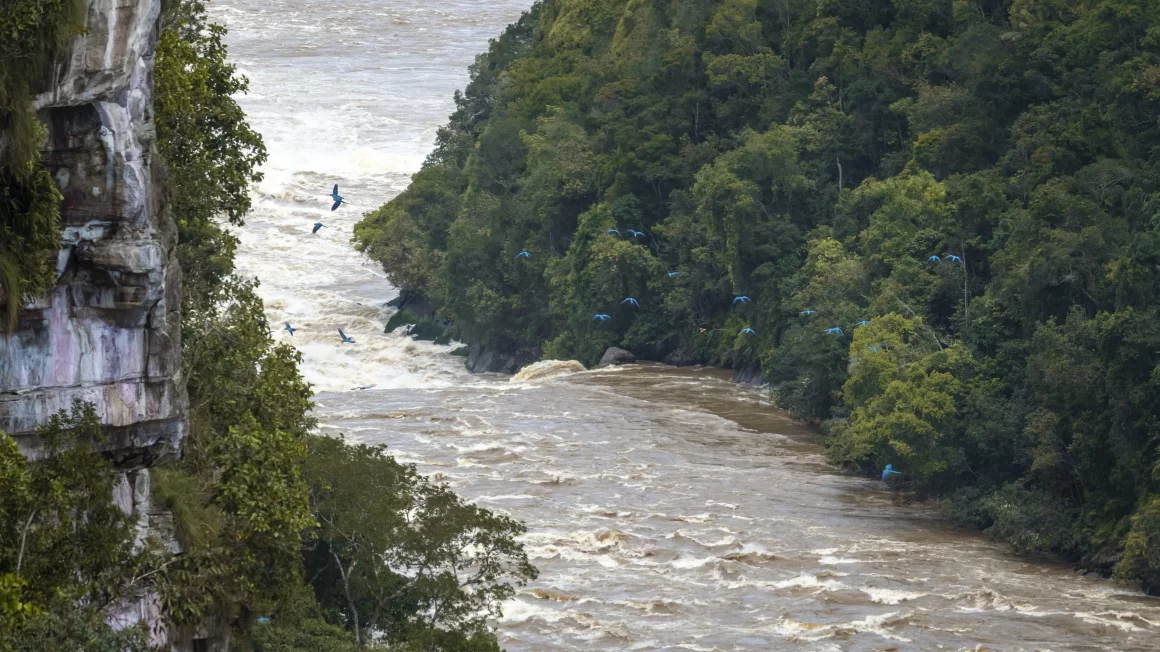
In “The Nest of the Macaws”, in Araracuara (Caquetá, Colombia), the river opens a path between ancient cliffs while a streak of blue cuts through the air. It is a moment that cannot be explained, only felt. Niko Jacob’s photograph captures that hidden pulse the Amazon keeps for those who know how to look.
The present is in our hands.
And though the challenge is immense, so is our capacity to act with clarity, with science, with sense and with purpose. To build a transition that is not a slogan but a path. To prove that progress can have roots, that development can have memory and that hope can have method.
If we listen to the rhythm of the forest, we can still tune our own.
And if we do it together, we can build a present worthy of living
and a future our children can inhabit with pride.