For Juana,
and for all the children who will inherit what we decide today.
Going to the store should be a trivial act. Walk in, grab something cold, pay, and move on.
But it isn’t anymore.
I stop in front of the fridge. I reach out and pull my hand back.
The bottle is there: transparent, correct, tempting. It promises immediate relief. I know its fate: five minutes of consumption, centuries of persistence.
Something breaks in that small gesture.
I don’t make a speech. I’m not trying to convince anyone. I simply can’t buy it.
That was the moment I declared war on the “personal” bottle.
It wasn’t a crusade or a revelation. It was fatigue. A persistent discomfort. It’s enough to look around—rivers, streams, beaches, streets—to understand that disposables stopped being a solution a long time ago.
Misunderstood reassurance
We grew up with a valid mantra: reduce, reuse, recycle. In that order.
But something drifted. The market took the final word and turned it into an excuse.
If it’s recyclable, it’s fine. If it has the recycling symbol—the triangle of arrows we all recognize—we stay calm.
Reality tells a different story. In Latin America, on average, less than 10% of plastic is recycled. The rest ends up in saturated landfills, in water, in soil, in the air.
Recycling is necessary, but it’s not enough to sustain a system designed to produce waste.
A recyclable container is not a recycled container.
And it’s far from a solved problem.
Changing packaging is not always changing the problem
When I stopped buying plastic bottles, I thought glass was the answer. Until I started reading without bias. Life-cycle analyses show something counterintuitive: a single-use glass bottle can have a similar or even higher environmental footprint than a plastic one. Weight, transport, and energy matter.
Glass becomes a better option when it is returnable and reused many times.
Switching plastic for glass without changing the system is, in many cases, just changing guilt.
And the unavoidable question appears:
if single-use plastic doesn’t work, and single-use glass doesn’t convince either… what do we do?
Reusable bottles and the illusion of doing the right thing
The solution seems obvious: bring your own container.
My daughter Juana, 10 years old, does. She has several reusable bottles. They’re fashionable at her school.
Last year I was invited to give a sustainability class to her classmates. I explained the problem of single-use plastics clearly. I struggled more when it came time to talk about solutions.
Someone raised their hand and asked:
—And if everyone buys reusable bottles, don’t we end up polluting more?
The point is simple: a reusable bottle only helps if it’s used for years, not if it accumulates.
Reusable works when it becomes habit, not trend.
The most sustainable bottle is the one that already exists—the one that gets scratched, dented, and carried everywhere.
Not the one replaced when fashion changes, nor the one that turns into a collection.
Data that doesn’t comfort
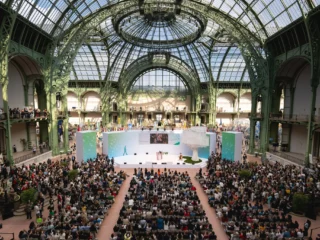
I attended a conference in Paris that still follows me. It was at ChangeNOW, a space where ideas don’t seek to comfort, but to put data on the table and open difficult questions.
The talk was Sian Sutherland – The Butterfly Effect of Plastic. It is intense and can be sensitive. That is precisely its intention.
I don’t share her approach entirely. Searching for absolute culprits simplifies a problem that is complex by nature.
But ignoring the data would be irresponsible: micro- and nanoplastics are in the air, the water, the food, and the human body. Recent studies have identified them even in brain tissue.
This won’t be solved with fear or slogans.
It requires judgment, context, and sustained decisions.
Circularity that does exist
That’s why projects that work in real life matter. At Energía Limpia we follow them because they help show that circularity is not a single formula, but different practices facing the same challenge.
Some work with recycled plastics and prove that design, durability, and market logic can close real loops:
The Loop Concept: circular design turning recycled plastic into durable objects
Others operate through recycling and reuse in territories where waste management remains an urgent challenge:
Ecotienda de Dibulla: community recycling in a territory that resists
And some, without working with plastics, demonstrate something just as important: substituting materials and rethinking objects from a circular economy perspective:
PAGURO: when rubble becomes home and sustainable design
Returning to these cases is not repeating content. It is reusing what still serves, recycling ideas that remain useful, and reducing noise to keep what matters.
None are perfect. All contribute.
The point of no return
I don’t believe in fanaticism.
I believe in sustained decisions.
For me, everything starts with something small: not buying that “personal” plastic bottle. Then come other choices: preferring returnable systems, using one reusable botlle and using it well, recycling what is unavoidable without turning recycling into an excuse, and reducing the production and consumption of disposables while understanding the system’s complexity.
It’s not perfect.
It’s responsible.
The “personal” bottle is not the biggest problem on the planet. That’s why it’s dangerous. It’s small, convenient, apparently harmless. It’s the exact symbol of our time: minimal decisions that, when added together, leave a footprint impossible to ignore.
Maybe change doesn’t begin with big speeches or total solutions.
Maybe it begins there, in front of the fridge, when someone decides not to reach out…
and keeps walking.