On turning fellow citizens into enemies—and the difficult work of rebuilding a country
I am not going to tell you how I voted.
I have begun to suspect that, in Colombia, we no longer ask people how they voted because we are genuinely interested in their political views. We ask because we want to know whether they belong on our side—or the other side.
Whether they deserve our trust.
Or our contempt.
That may sound exaggerated.
I wish it were.
If I said I voted for Iván Cepeda, part of the country would stop seeing Juan Daniel Correa altogether. Overnight, I would become a sympathizer of guerrillas, an accomplice of criminals, an enemy of enterprise, security, freedom, and common sense. If I said I voted for Abelardo de la Espriella, the opposite would happen. I would become a corrupt oligarch, an enemy of culture, of the environment, of animals, of clean energy, and of any idea associated with progress.
And if I admitted that I voted blank, things might be worse still. At least the other camps have tribes willing to defend them. A blank vote tends to inspire a special kind of contempt. I would be labeled weak, indecisive, mediocre, unwilling to choose a side when, according to both camps, the future of the Republic hangs in the balance. Somehow, I would become responsible for the victory of one side and the defeat of the other.
The disturbing part is not the insults.
The disturbing part is how easily a person disappears behind them.
Judgment arrives before conversation. Labels appear before arguments. A single electoral choice becomes a complete explanation of someone’s character. Little by little, we have begun replacing citizens with caricatures.
And perhaps that is the most important story unfolding in Colombia today.
Not because it determines who will occupy the presidential palace.
Not because it settles a fiercely contested election.
But because it reveals what we are becoming while we argue about everything else.
Elections end. Governments end. Even crises end.
What remains is the way a society learns to look at itself.
As I write these lines, part of the country is celebrating while another part is grieving. Some speak as though a new era has begun. Others as though darkness has already fallen. Some feel ownership of victory. Others feel condemned by defeat.
And yet the real country remains.
The streets wake up unchanged. Shopkeepers raise their shutters. Street vendors return to familiar corners. Buses remain crowded. People go to work. The mountains watch over the cities with the same indifference they always have.
A few minutes on social media are enough to reveal two different Colombias: one convinced it has just saved the Republic, the other convinced it has just lost it.
And that is when I find myself returning to three conversations through which I have spent years observing this country: energy, sustainability, and culture.
While millions argue about winners and losers, transmission lines still wait to be built. Energy projects continue to face regulatory, financial, and social barriers. Reservoirs still depend on rainfall. The climate continues to move according to its own logic.
Nature does not know who won the election.
Droughts do not vote.
Climate events have no ideology.
Neither does the electrical grid.
For years we have debated the energy transition as though it were a struggle between irreconcilable visions of the country. Some speak as if oil and gas were a moral offense. Others behave as though environmental concerns were a threat to prosperity.
Meanwhile, reality keeps waiting.
Colombia has made progress in renewable energy, but the transition continues to fall short of what the country requires. Delays in strategic projects in La Guajira, difficulties expanding transmission infrastructure, obstacles to connecting new generation capacity, and the growing gap between announced goals and actual execution all suggest that the work remains unfinished.
The most important word in this debate is also the one most frequently forgotten:
Transition.
Not rupture.
Not crusade.
Transition.
A process that demands environmental ambition, technical rigor, investment, and the capacity to deliver.
Colombia contributes only a tiny fraction of global greenhouse gas emissions, yet it ranks among the countries most vulnerable to climate change. That paradox alone should force us to think more carefully.
Because slogans do not generate electricity.
And political extremes do not produce a single kilowatt.
The same pattern appears in culture.
For too long, we have treated culture as something secondary—a luxury to be discussed once the “real” problems have been solved.
And yet governments disappear much faster than songs.
Ministers fade before stories do. Policies pass before traditions do. Administrations come and go while the memories, celebrations, and shared narratives that allow a society to understand itself remain.
Culture is not an accessory of nationhood.
It is part of the fabric that holds a society together.
That is why culture requires more than speeches. It requires sustainability, stewardship, and the ability to create value without losing its soul.
The same can be said of animal welfare, another issue increasingly trapped by polarization. Colombia has made meaningful advances in the protection of animals. Those achievements deserve recognition. What they do not deserve is to become another front in an endless political war.
Because experience teaches something simple.
Most people do not vote out of hatred.
They vote out of a complicated mixture of hope, fear, memory, frustration, aspiration, and conviction.
That is why I find it difficult to believe that millions of Colombians voted for Abelardo de la Espriella because they want to destroy nature or culture. And I find it equally difficult to believe that millions voted for Iván Cepeda because they sympathize with criminality or reject private enterprise.
Both simplifications produce the same result.
They replace real people with imaginary characters.
Meanwhile, the real country keeps waiting.
Waiting for stronger institutions. Better opportunities. Better schools. Better energy solutions. Better conversations.
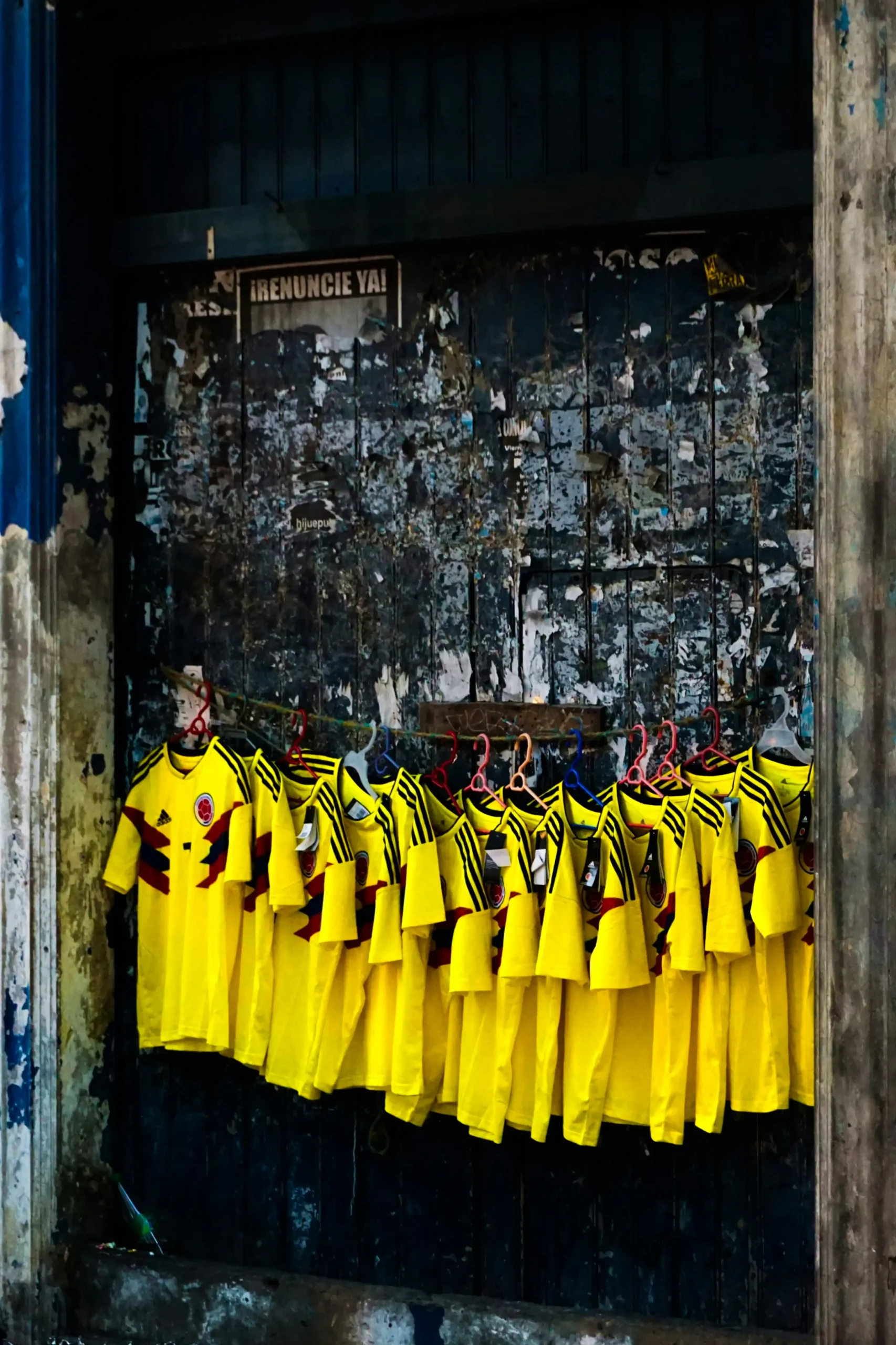
Perhaps that is why I find it revealing that even the jersey of Colombia’s national football team became entangled in the electoral debate. It may seem like a minor anecdote, but it says something profound about us.
A society that learns to distrust everything eventually begins to distrust even its shared symbols.
Tomorrow Colombia will play another World Cup match. Millions of people who today insult one another online will wear the same yellow jersey, sing the same anthem, and celebrate the same goals. For ninety minutes they will remember something politics seems determined to make us forget:
We share far more than what divides us.
This is not a new idea.
Germany experienced something similar after the fall of the Berlin Wall. Reunification had taken place only months before the 1990 World Cup. The country was still trying to reconcile different histories, different experiences, and different ways of understanding itself. Football did not solve those tensions, nor did it erase differences overnight.
But winning that World Cup helped create a powerful image: millions of people recognizing themselves once again beneath a common flag and as part of a shared community.
Colombia does not need unanimity.
It does not need ideological conformity.
It does not need a single way of thinking.
What it needs is the ability to disagree without turning disagreement into permanent warfare.
Perhaps that is why I have always found something deeply meaningful in one of the most famous lines of Colombia’s national anthem:
“The horrible night has ended.”
We all sing it.
Few of us pause to reflect on it.
Because the horrible night does not end when our candidate wins.
It does not end when we humiliate our opponents.
It does not end when politics becomes a religion.
It does not end when electoral victory is confused with moral superiority.
The horrible night ends when we become capable of building something together.
Which is why it is striking that, in the midst of such a bitter campaign, God became such a visible presence in the rhetoric of every side. In a deeply religious country, faith returned to public squares, debates, and social media feeds. References to Christ, divine providence, the Virgin Mary, and Christian values suddenly became commonplace—even among voices that had not always placed religion at the center of their public identity.
It is not my place to judge the sincerity of those beliefs.
But it is worth remembering that the great spiritual traditions ask something more difficult than winning elections.
They ask for humility.
And that is when my thoughts return to a passage from Ecclesiastes that seems written for moments like this:
“To everything there is a season, and a time for every purpose under heaven… a time to cast away stones, and a time to gather stones together.”
For too long we have specialized in scattering them.
We have thrown stones from campaigns, from governments, from opposition movements, from television studios, from newspapers, and from social media platforms. We have learned to suspect before listening, to classify before understanding, and to condemn before speaking.
Perhaps it is time to try something different.
Because after the speeches, the victories, and the defeats, the same country will still be here: the mountains, the rivers, the forests, the artists, the entrepreneurs, the farmers, the animals, the energy challenges, and the cultural questions we have yet to answer.
Colombia will still be here.
And perhaps the most important question is no longer how we voted.
The question is what we are going to do with the country that remains when the celebration of some and the disappointment of others have faded.
For too long we have excelled at separating, accusing, and throwing stones.
The time has come to gather them.
The time has come to build something far more difficult—and far more important: a country capable of debating without destroying itself, correcting itself without hating itself, and understanding that energy, sustainability, culture, and democracy can only flourish when there is still a community willing to recognize itself as one.
The time has come to gather the stones.
The time has come for Colombia.