
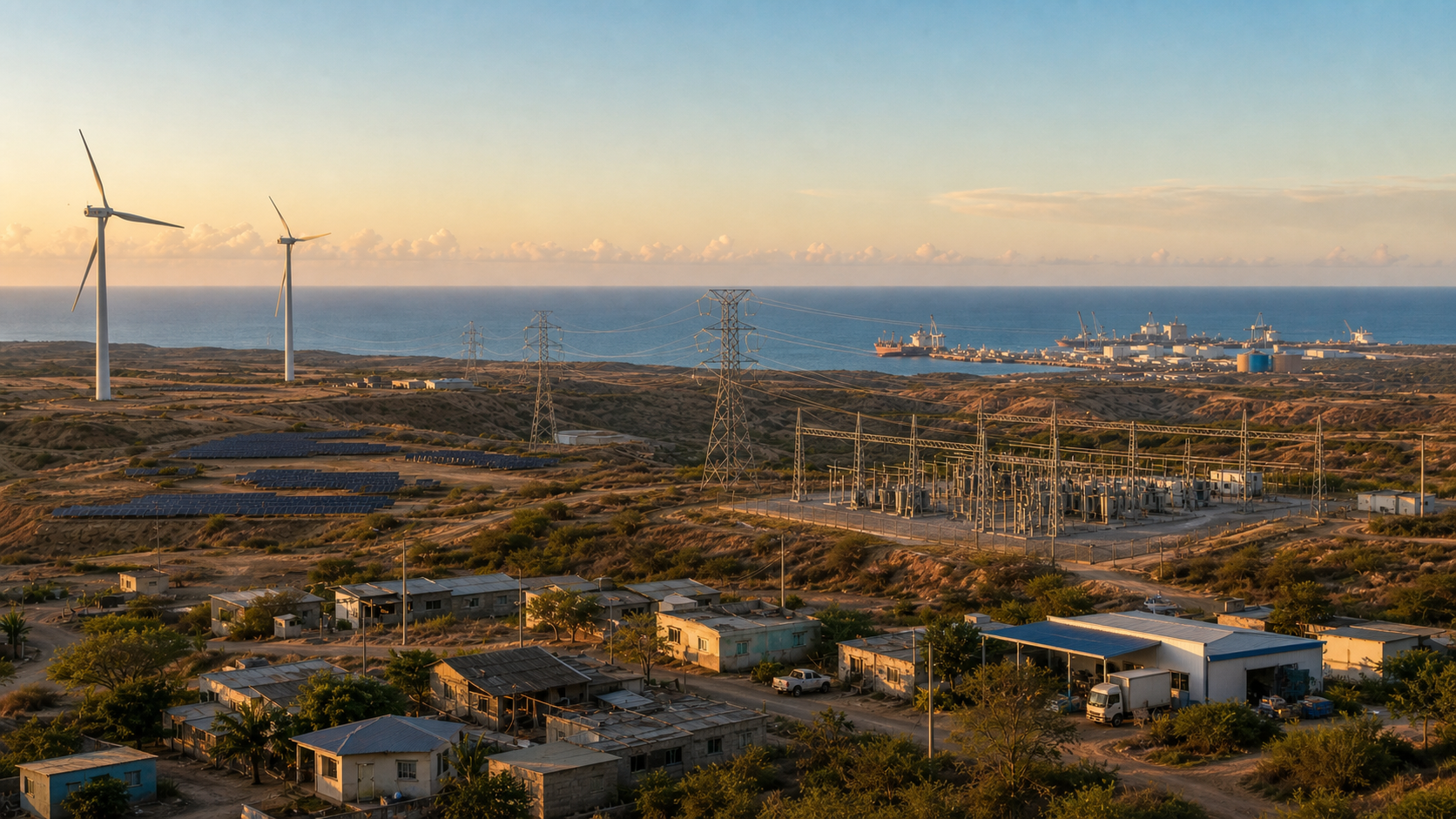
A critical look at Colombia’s new energy era, drawing on Adriana Espinel’s contribution to the Bogotá Chamber of Commerce Energy Cluster.
Colombia has spent years talking about its energy potential. It measures it, announces it, and multiplies it across presentations. The country has sun, wind, water, natural gas, coal, biomass, and the promise of hydrogen. On paper, Colombia appears to have it all.
The problem is that potential is not the same as available energy. It does not power a home, keep a business running, or transform a region.
The numbers bring the debate down to earth. For 2026 and 2027, the estimated annual gap between demand and firm energy—the supply that can be guaranteed when the system needs it—is 7,207 gigawatt-hours. Of the 4,475 megawatts expected to come online in 2026, only 724.8 megawatts, or 16.2%, had entered operation by August 20. Meanwhile, electricity demand was growing 6.68% year over year.
Consumption is moving forward. New capacity is not keeping pace.
Add to that four consecutive months of below-average water inflows, imported gas accounting for 29% of the gas traded in June—at a price nearly 77% above domestic supply—and proven reserves equal to 5.9 years of gas production and 7.4 years of oil production.
This is no reason to panic. It is a reason to watch the clock.
The discussion calls for a different angle. Colombia has multiple sources of energy; the challenge is turning that potential into available supply, industry, and growth.
Between potential and results stand the grid, financing, permitting, regulation, communities, and one word that leaves little room for speeches: execution.
No Technology Is Coming to Save Us
Much of the energy debate has been framed as a contest. Renewables versus gas. Hydrogen versus fossil fuels. Energy transition versus energy security.
Gas does not become clean by decree. Renewables do not become firm through enthusiasm. Every source carries different advantages, costs, risks, and functions. The useful question is not which one should prevail, but which combination can provide reliable, affordable, and increasingly cleaner energy.
That is where energy convergence comes in: integrating technologies within one system instead of setting them against each other. Solar and wind, natural gas, hydropower, storage, grids, and demand management can perform complementary roles.
The focus moves from the source to the outcome; from announced capacity to connected capacity; from supply to demand; from the project to the business case.
Energy policy is usually organized around three goals: security, to ensure supply; equity, to expand access at affordable prices; and sustainability, to reduce emissions and environmental impacts. The proposal adds a fourth: responsible abundance.
This does not mean producing energy without limits. It means having enough to expand access, attract investment, and build industry while delivering measurable emissions reductions and respecting ecosystems and communities.
Adriana Espinel captures the approach in one sentence: “Colombia does not have to choose between energy and transition. It has to learn how to turn energy into development.”
I share that vision. It breaks with a false choice that has impoverished the debate and sets a more demanding measure of success: reliable energy, industry, well-being, and emissions that are actually reduced.
The Business of Delivering Energy
A power plant without a grid connection is a stranded asset. A renewable project without transmission produces expectations before it produces electricity. Installing capacity is only part of the job.
The most immediate opportunity lies in infrastructure: grids, substations, interconnections, storage, advanced metering, automation, digitalization, cybersecurity, and demand response. These are the assets and services that transport energy, provide backup, and make better use of available capacity.
For years, Colombia celebrated projected megawatts. Connected megawatts are less abundant—and far more useful.
This opens a broad field for engineering, construction, technology, operations, maintenance, and specialized service companies. The business is not limited to generating energy. It also lies in making sure energy can arrive and perform.
Delivering energy includes communicating it and making it understandable. A project can connect to the grid and still remain disconnected from society if companies, communities, and citizens do not understand what is being built, what will change, and what is at stake.
The energy future may begin in a laboratory, but it does not end there. It needs infrastructure to reach the system and clear communication to reach society.
What If Colombia’s Best Energy Export Is Not Energy?
The question can shift: instead of thinking only about how to export energy, which industries could Colombia attract to transform that energy at home?
Data centers for artificial intelligence, mineral processing, cold chains, fertilizers, petrochemicals, and advanced manufacturing all require abundant, reliable energy. Attracting some of these activities would turn an energy advantage into production, employment, and knowledge.
The timing may be favorable. In markets where data-center demand is growing rapidly, projects can wait four to eight years for a grid connection capable of guaranteeing the power they require. According to an estimate cited during the session, only one in twenty projects in those queues may ultimately be built.
The congestion reveals a new form of scarcity: investment and demand exist, but grids and available connections do not. For Colombia, speed and certainty of access to energy could become a competitive advantage.
The country has an opportunity, not an entitlement. Sun, wind, and geography matter. So do regulatory predictability, available infrastructure, permitting timelines, and the capacity to execute.
If Colombia can bring those conditions together, it can export something more valuable than an electron or a molecule: products manufactured in the country with competitive energy, local employment, and embedded knowledge.
The Caribbean: Power and Debt
Some of Colombia’s strongest winds blow across its Caribbean region. Sunshine is abundant; natural gas lies beneath the sea; coal and biomass are found on land; ports, refining, and petrochemicals operate along the coast. Few regions bring so many forms of energy together in one place.
And yet, in too many homes, energy remains unreliable, unaffordable, or insufficient. In 2025, 26.4% of households in the region experienced energy poverty.
Energy everywhere. Energy security inside far too few homes.
The Caribbean has the conditions to become an industrial transformation platform where natural gas, renewables, ports, water, petrochemicals, new molecules, and manufacturing converge. The risk is repeating a familiar story: extracting resources, moving value elsewhere, and leaving too little of the resulting wealth in the territory where it was produced.
Changing the energy source achieves little if jobs, industry, and well-being continue to leave the region.
The relationship with communities is part of this equation. When participation arrives at the end—reduced to outreach, compensation, or procedure—distrust often arrives before the projects do. It is then labeled “social conflict,” as though it had emerged through spontaneous generation.
What is at stake in the Caribbean is not only the ability to produce more energy. It is the opportunity to turn that energy into industry, capabilities, employment, and well-being.
The wind, sun, and gas should not simply pass through.
Resources should not be the only thing leaving. Development should arrive as well.
Colombia, Venezuela, and the United States: A Strategic Bet
A corridor linking Colombia, Venezuela, and the United States no longer looks like a purely speculative exercise. Several pieces have begun moving at once.
Colombia’s new government has identified the United States as its leading trade and investment partner. Washington, in turn, has placed Venezuela back at the center of its energy agenda: during 2026, it authorized U.S. operations, investments, and services involving Venezuelan oil, gas, petrochemicals, and minerals. Colombia also updated the rules governing electricity exchanges with Venezuela.
The potential complementarity is powerful: capital, technology, and buyers from the United States; natural gas and interconnection from Venezuela; and Colombia as an energy, industrial, and logistics hub.
The scale deserves attention. Colombia and Venezuela have nearly 40 gigawatts of installed capacity and, according to the estimates cited, more than 300 gigawatts of technical potential across natural gas, hydropower, solar, wind, biomass, and other sources.
The corridor could extend far beyond trading electricity or hydrocarbons. Grids, storage, fertilizers, petrochemicals, minerals, ports, data centers, and manufacturing could form a value chain connecting the resources of northern South America with U.S. demand, capital, and technology.
Colombia would occupy a distinctive position: a bridge between two countries reconnecting through energy, capable of turning that relationship into infrastructure, industry, and employment.
Geography provides the meeting point.
Execution can turn it into an energy and industrial hub.
Hydrogen After the Hype
Hydrogen is not an energy source waiting to be extracted. It is an energy carrier: it must be produced from electricity or other energy sources and then compressed, stored, transported, or transformed. Every stage consumes energy and adds cost.
Distance matters. Shipping pure hydrogen can require more than 10 kilowatt-hours per kilogram—over 30% of its energy content—through liquefaction and reconversion, according to the International Energy Agency. This is why using hydrogen close to the buyer, or converting it into products with established logistics chains such as ammonia and methanol, can be more viable.
Colombia can focus hydrogen development along four practical pathways: reducing emissions in refineries and fertilizer plants, where demand already exists; producing derivatives that are easier to store and sell; operating electrolyzers flexibly when electricity is abundant and competitive; and developing clusters that integrate generation, natural gas, water, carbon capture, ports, and industry.
All four share the same logic: bring the molecule closer to its use, leverage available infrastructure, and focus on processes where emissions reductions can be measured.
Buyer, cost, logistics, and environmental performance. These are the variables that separate an industrial project from a promising idea.
Hydrogen gains value when it finds a practical application—when it stops being a promise and starts becoming an industry.
Energy Is Where the Future Will Be Decided
Energy is the infrastructure that supports all other infrastructure. Data centers and artificial intelligence need it, but so do hospitals, industries, small businesses, and every household expecting reliable service at a reasonable price.
Its availability, cost, and reliability shape competitiveness, employment, security, regional development, and quality of life. Energy is no longer an issue confined to the energy sector. It runs through the entire country.
Adriana Espinel’s contribution places one decisive question at the center of the debate: how can Colombia turn available energy into development?
This is Colombia’s energy moment because many of the decisions that will define the coming years depend on it: which projects connect, which industries establish operations, which jobs are created, and where the country positions itself in emerging value chains.
The opportunity is broad. So is the work ahead: grids built, projects operating, buyers identified, predictable rules, communities involved from the beginning, and deadlines that are actually met.
Execution gets projects running.
Communication allows companies to recognize opportunities, communities to understand impacts, and citizens to know what is changing, what it costs, and what results they should expect.
For years, Colombia measured its energy horizon in available resources and announced megawatts. It can measure it differently: energy delivered, households better served, companies growing, products manufactured in Colombia, and value remaining in the regions where that energy is generated.
The potential has been measured. The opportunity has been identified.
Now comes the work of connecting energy, transforming it, explaining it, and turning it into well-being.
That is where the future will be decided.
Sources and References
- Adriana Espinel, Colombia’s New Energy Cycle: Where Will the Opportunities Be?, presentation for the Bogotá Chamber of Commerce Energy Cluster, August 27, 2026.
- XM, bulletins and releases on electricity demand, water inflows, and reservoir levels, August 2026.
- Mining and Energy Planning Unit (UPME), monitoring of new generation projects entering operation, August 2026.
- National Hydrocarbons Agency (ANH), 2025 Resources and Reserves Report.
- Campetrol and the Colombian Mercantile Exchange, data on the share and price of imported natural gas.
- International Energy Agency, Global Hydrogen Review 2026.
- U.S. Energy Information Administration, Annual Energy Outlook 2026.
- Ministry of Mines and Energy, rules governing electricity exchanges with Venezuela, July 2026.
- U.S. Department of the Treasury, Office of Foreign Assets Control, licenses related to energy operations in Venezuela, 2026.