
Photo: Juan Diego Cano / Office of the President of the Republic
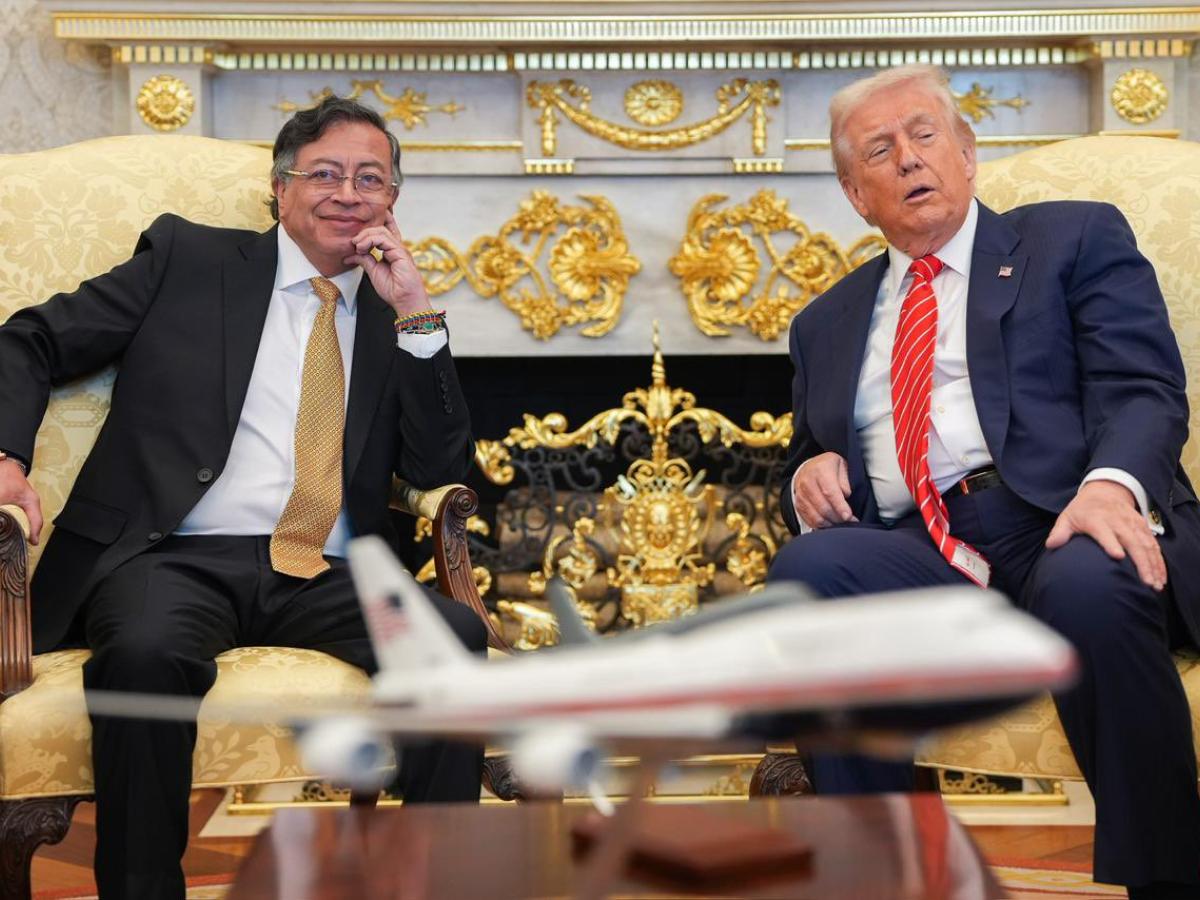
At the White House, Donald Trump and Gustavo Petro shook hands and declared their meeting “successful.” The tone was cordial. The message, diplomatic. Many framed it as a victory for foreign policy. But once the cameras were off and the substance examined, an uncomfortable conclusion emerged: the energy transition came out weaker than it went in.
The positions are opposite and irreconcilable.
And, for better or worse, one is far more consistent than the other.
Trump does not hide. He says drill, baby, drill and acts accordingly: more exploration, more production, more state support for the fossil fuel industry. It is a dangerous and regressive stance. But it is coherent. What he says is what he does.
Petro proposes the opposite: Latin America supplying clean energy to cover 100% of the United States’ energy matrix. A continental energy transition. The problem is that this is not a plan—it is a fantasy. It lacks technical, industrial, and financial grounding. More critically, Petro has not been able to put an orderly energy transition in place even in his own country, Colombia.
Colombia continues to depend on oil, gas, and coal.
And that, in itself, is not the problem.
The energy transition is not a war against fossil fuels. It is a process. We still need them—and will for decades—to sustain the economy, fiscal stability, and energy security while real alternatives are built. Demonizing fossil fuels does not meaningfully reduce global warming; it does scare away investment and weaken economies.
The real problem lies elsewhere: regulatory uncertainty, contradictory signals, and the absence of a clear technical roadmap. This has cooled investment, stalled projects, and turned the energy transition into a political narrative rather than public policy.
If Colombia has not been able to manage its own energy system rigorously—integrating fossil fuels, renewables, power grids, and storage—it is implausible to claim it can redesign the largest and most complex energy system in the world.
That is the core difference:
Trump defends something many of us reject, but can execute.
Petro promises something many applaud, but cannot deliver.
The real agenda confirmed it. Yesterday, there was no discussion of power grids, energy storage, renewable industry, or long-term financing. The conversation revolved around security, drug trafficking, Venezuela, and gas. The idea of moving Venezuelan gas through Colombia even surfaced. Fossil energy solving what clean rhetoric cannot.
The United States consumes roughly 4,000 TWh of electricity per year, and more than 60% of its total energy supply still depends on oil and gas. That cannot be changed through speeches or symbolic summits. It requires decades of infrastructure, stable rules, and patient capital. None of that was on the table.
The conclusion is uncomfortable but unmistakable:
while Petro speaks, the transition becomes a slogan;
while Trump drills, the fossil system advances.
And the most serious problem is not that there will be more oil and gas—there will be.
The real danger is that climate demagoguery strengthens denialism: it promises the impossible, fails at the basics, and strips the energy transition of credibility.
So while both presidents smile for the cameras, they “give the finger” to those who believe in a serious, technical, and responsible energy transition. One does it through explicit cynicism. The other through empty epic rhetoric.
Yesterday was not a diplomatic victory.
It was a warning.
Because the energy transition will not fail because of oil.
It may fail because of lies.
And as long as politics prefers applause over truth,
clean energy will remain a grand promise,
well photographed,
but technically hollow.