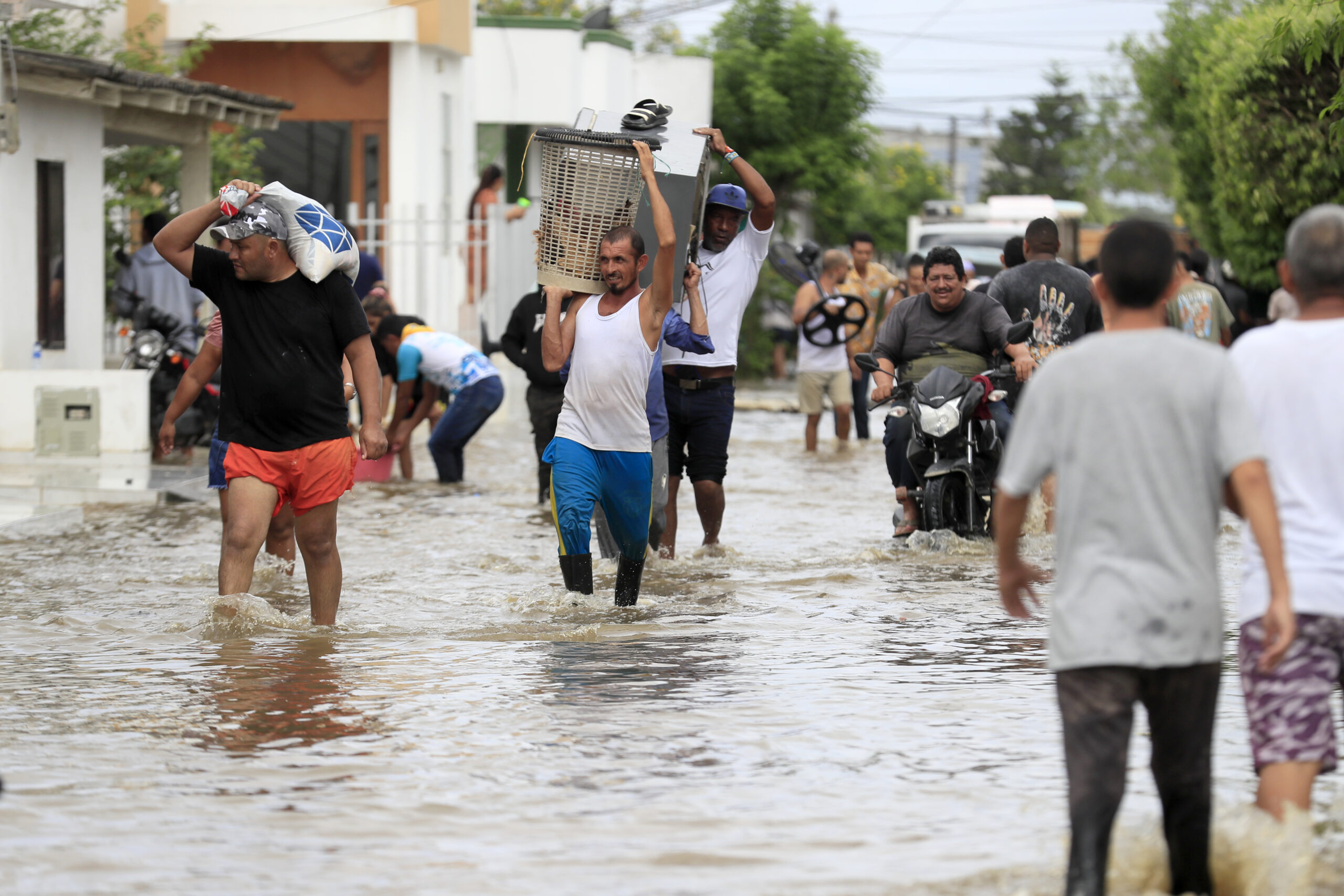
Flooding in Montería, Córdoba: the human cost of water abundance. Photo: EFE / Carlos Ortega
We were spared.
But it wasn’t good news.
Colombia avoided an energy crunch thanks to heavy rains. By early 2026, reservoir levels rose above 76% of useful capacity, and hydropower once again carried the electricity system. Power flowed. Immediate risk faded.
But that relief came at a cost.
A very high one.
During the same period that filled reservoirs, the country recorded more than 600 rain-related emergencies and over 155,000 affected families. Floods, landslides, destroyed roads, and crop losses. Departments such as Córdoba, Antioquia, and Chocó reported severe damage. The Urrá I reservoir exceeded 102% of capacity, forcing controlled spillways while downstream communities flooded.
The paradox is stark: the water that stabilized energy production also produced tragedy.
This is not a positive balance.
It is a warning.
Colombia still depends on water. When it rains, the system appears strong. When it doesn’t, fragility emerges. The national meteorological authority has already signaled the likelihood of drier conditions in the second half of 2026, implying reduced inflows and increased pressure on reservoirs.
Excess and scarcity.
No management in between.
Here lies the structural problem: the country does not manage water. It lets it run.
Colombia receives on average more than 2,600 millimeters of rainfall per year, with regions exceeding 6,000 millimeters—among the wettest on Earth. Yet wastewater treatment barely covers half of what is generated, reuse is minimal, and storage infrastructure remains limited. Excess becomes disaster. Scarcity becomes crisis.
We do not store.
We do not reuse.
We do not plan.
And when disaster arrives, the blow is doubled.
The National Unit for Disaster Risk Management — the agency meant to prevent and respond — became entangled in one of the most serious recent scandals: roughly 1.4 trillion pesos under scrutiny, the purchase of 40 water trucks for 46.8 billion pesos with estimated overruns between 16 and 20 billion, and irregular contracts that, according to investigations, involve at least 92 billion pesos. The Comptroller General has estimated that the impact of corruption could exceed 60 million dollars since 2022.
While the country floods, the money meant to prevent emergencies dissolves.
Resources that could have translated into prevention, infrastructure, and resilience.
Today they are part of the problem.
Rain filled the reservoirs.
But it flooded territories.
Energy stabilized.
But thousands of families lost everything.
And the institutions meant to protect them failed as well.
That is not success. It is improvisation.
And yet, official discourse insists on presenting energy policy as an achievement. The technical reality shows otherwise: a matrix still tied to water, diversification progressing more slowly than announced, and water management practically nonexistent. Without structural planning, outcomes remain subject to climate rather than public policy.
Mistaking a rainy season for a policy achievement is not only wrong. It is dangerous.
The electricity system remains conditioned by climate. The matrix is still concentrated, and diversification advances more slowly than required. When reservoir levels drop, the margin for maneuver will be narrow. And then the country will realize it let millions of cubic meters pass without turning them into resilience.
Colombia must treat water as strategic infrastructure: storage, reuse, regulation, territorial planning, and real energy diversification. Not as a reaction to emergencies, but as state policy.
Today, the country was spared an energy crisis.
But at the cost of more disasters.
And a system that needs disaster to function has failed.
—
Sources: IDEAM; XM; National Unit for Disaster Risk Management (UNGRD); Office of the Comptroller General; Ministry of Housing; official reports and institutional releases 2025–2026.