
1. Panorama in Spain and the Valencian Community
The Government has approved a royal decree regulating the installation of floating photovoltaic plants in public hydraulic reservoirs: concessions will last up to 25 years and may cover between 5% and 15% of the reservoir’s surface, depending on water quality and other factors.
In the Valencian Community, reservoirs such as Bellús (92 MWp), Beniares (34 MWp), La Forata (10 MWp), and Algar (5 MWp) have been identified as ideal candidates for this type of facility.
2. Key benefits of the floating system
- Higher energy efficiency: The cooling effect of the water can increase performance by 5% to 10%.
- Evaporation reduction: Can reduce water loss by up to 70% in warm climates.
- Space optimization: Reuses water surfaces, avoiding competition with agricultural or natural land.
- Synergy with hydropower plants: Being located near existing infrastructure makes grid connection easier, with lower cost and impact.
3. Local innovation from the port of Valencia
Valencian startup PV Nexus launched the PVFOILX1-PORTS prototype: a modular floating photovoltaic system with flexible panels, over 90% made from plastic materials, installed in port waters. The system is IoT-controlled and aims to scale up to larger designs, even integrated with green hydrogen production.
4. International context and outlook
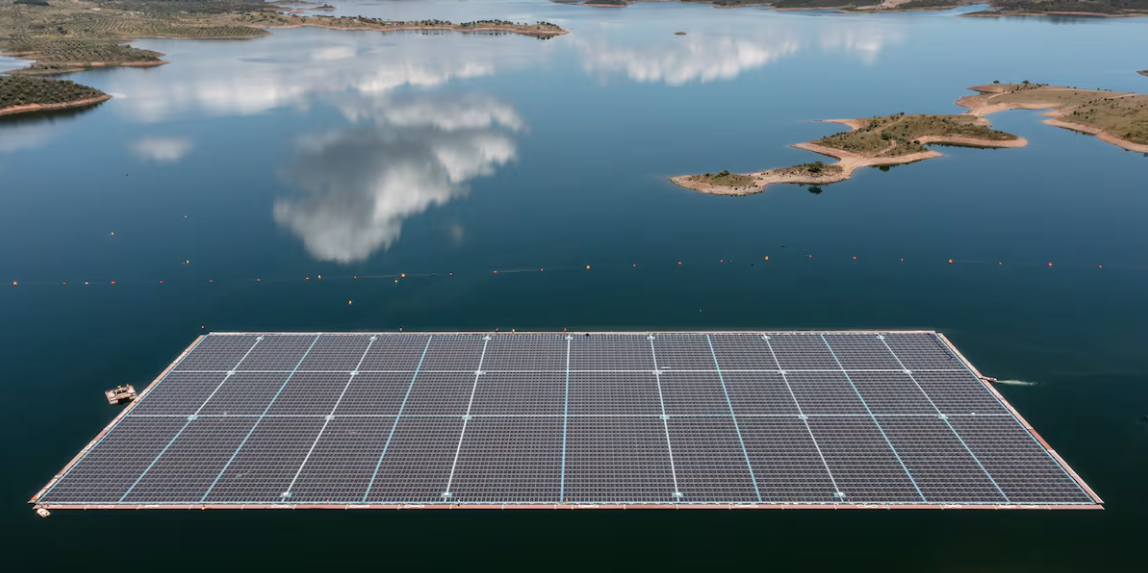
Portugal inaugurated in 2022 the Alqueva floating park, the largest in Europe: it generates 7.5 GWh annually, uses panels mounted on cork and recycled plastic floats, and was awarded by the EU for its innovation. These systems have proven to enable effective hybridization when combined with hydropower plants, allowing solar surpluses to be used and energy storage to be optimized.
However, in Spain, installation and maintenance costs remain higher than for ground-mounted solar, and adequate incentives are still lacking.
5. Opportunities for Colombia
- Potential for large reservoirs: Sites like Guatapé, Urrá, or El Peñol could benefit from combining clean generation with evaporation mitigation.
- Natural cooling and higher performance: Would increase energy efficiency and extend panel lifespan.
- Compatibility with hydropower plants: Sharing infrastructure and facilitating connection could lower costs.
- International support: Portugal’s Alqueva model serves as an innovative and efficient reference. With goals like achieving 70% non-conventional renewables by 2050, Colombia has an excellent opportunity to replicate and adapt this technology.
For Colombia, this technology represents a strategic opportunity: integrating renewable energy, water efficiency, and synergy with existing resources.
Featured image credits: “A floating photovoltaic installation, in the Alqueva reservoir (Portugal).” EDP