
Written by: Felipe Restrepo Galán – Graduate in Social Communication from Pontificia Universidad Javeriana, with an emphasis on audiovisual and editorial fields. A creative, storyteller, and dreamer in constant pursuit of transforming ideas into stories that move and endure.
At first, nobody suspected a thing. Green seemed like an unbreakable promise: it was on supermarket packaging, on billboards lining the highways, on commercials interrupting domestic routines. Green as a symbol of the future, green as the certainty that there was a way out. EcoCorp had managed to appropriate that color with an almost obscene ease, until it became inseparable from its name. Green was no longer grass, nor leaves, nor mountains; it was a logo, it was merchandise.
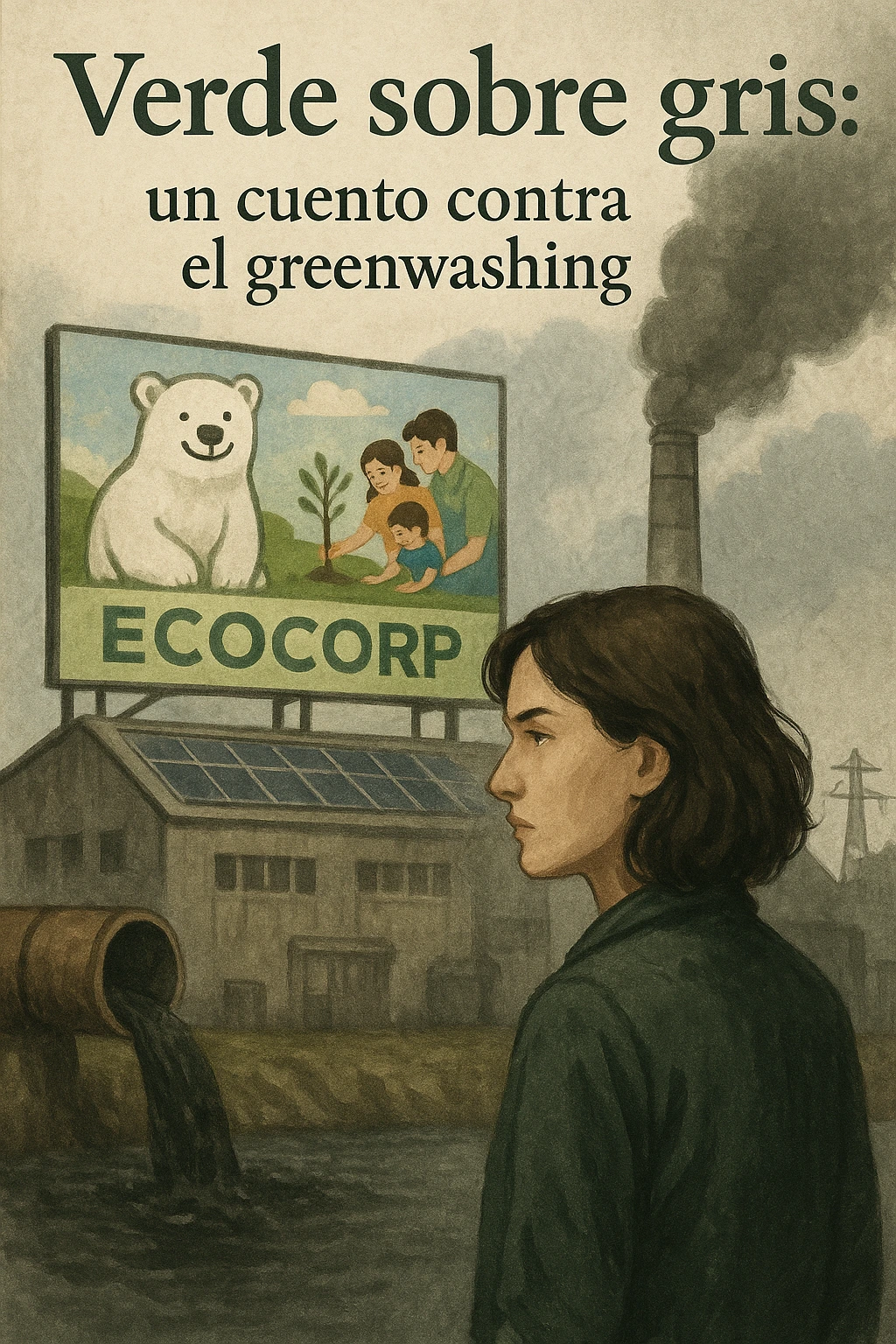
The ads were flawless in their tenderness: a smiling polar bear, a family planting trees in a field that never seemed to have mud, a plastic bottle shining under the slogan “100% recyclable.” These were images that appealed not to reason but to guilt, to that collective desire to feel that with each purchase, one’s conscience was washed clean. Sofia, however, could never believe in such perfection. There was in those scenes a forced stillness, as if behind every smile there were a curtain. And when one suspects a curtain, one inevitably imagines what lies behind it. It was that suspicion—persistent, uncomfortable, almost physical—that led her to infiltrate the heart of the company.
The first factory she visited confirmed what had until then only been intuition. From a distance, it looked like a model of modernity: solar panels gleaming like mirrors on the roof, trucks with green slogans moving in and out with choreographic precision. But as soon as Sofia stepped out of the car, the acrid smell enveloped her—sticky, invasive, like an involuntary confession. And on one side of the property, almost invisible, a pipe spewed dark waste into the river flowing toward nearby communities. The workers, with loose masks and dull eyes, moved with a resignation that revealed this was neither an accident nor a temporary error: it was routine.
Her investigation became an inventory of deceit. The “recyclable plastic” could only be reprocessed in a few specialized plants that most consumers would never reach; in practice, almost all of it ended up in regular trash. The “biodegradable detergent” contained chemicals that dissolved in rivers only to wipe out aquatic life. The idyllic countryside in the ads was a plot bought for photo shoots: a cheap stage set, while on the other side of the country entire hectares of primary forest were being destroyed.
EcoCorp’s green, Sofia realized, was nothing but a carefully crafted mask to cover a gray background: the gray of polluted water, of diseased lungs, of felled trees, of concrete advancing where rainforest once stood. Gray of a reality that would never make it to television.
When she published her report, the public reaction was immediate. Outrage, boycotts, lawsuits that sent the company’s stock plummeting. But Sofia, amid the media noise, felt something quieter, deeper: a raw sadness. Because EcoCorp was not an exception, but a model; not an isolated monster, but a multiplied mirror. The true scandal was not the lie of a single company, but the ease with which everyone—consumers, shareholders, governments—had wanted to believe it.
“Green over gray”: that’s how she wrote it in her notebook, as a title that imposed itself without asking. Because that was the world she now inhabited: one where green had ceased to be hope and had become a disguise. And where beneath it, always, was gray.
And to the companies that still insist on dressing up their greed with a green veneer, Sofia would leave a reminder: greenwashing is not a marketing strategy, it is a sentence. Because in a world increasingly alert and increasingly exhausted, the lie doesn’t just destroy forests and rivers—it destroys the little trust that remains. The danger is not only environmental, but moral. And once that trust is lost, no green will ever be enough to cover the gray.