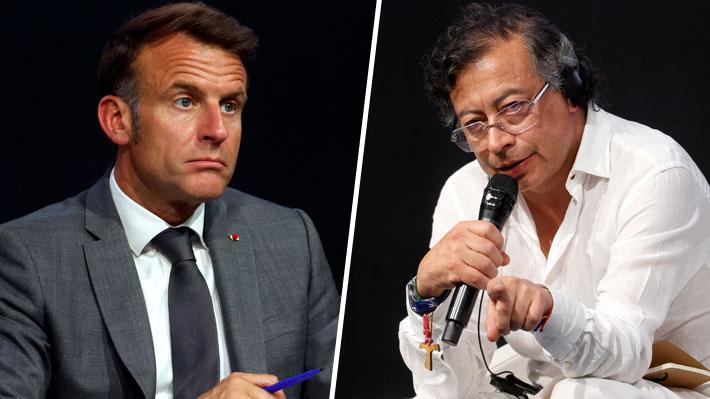
Yesterday, during the International Conference on Financing for Development in Seville, Spain, an episode took place that, beyond political anecdote, leaves us with a profound reflection on sustainability and the role we play—or believe we play—in building it.
The President of France, Emmanuel Macron, demanded respect from the President of Colombia, Gustavo Petro, after the latter used his remarks to lash out at developed countries for their historical role in the climate crisis and global inequality. Macron, visibly uncomfortable, responded: “I know the key paradigm of your policy, but I never lecture someone from the South. And it’s a bit strange to receive lessons from someone from the South simply because they come from the South. I demand the same kind of respect.”
Here is one of the videos documenting the moment, published by El País (also available on other platforms):
The scene was uncomfortable but above all revealing. Revealing because sustainability is not about lecturing others—especially when, as so often happens, the one doing the lecturing does not practice what they preach.
Real sustainability—not the one from speeches—is a practical construction, not a rhetorical exercise. It is more action than talk. More about taking responsibility and facing life than about assigning blame.
At Clean Energy (Energía Limpia), we welcome that Macron reminded Petro that pontificating is not the same as building. That the gesture of “giving lessons” while ignoring one’s own inconsistencies is, to put it mildly, contradictory.
We have said it before, even referring to Donald Trump—who stands on the opposite political shore: when we were in Paris covering Change Now (you can read it here: Reflections on Change Now 2025), we were pleasantly surprised to see attendees wearing caps that read “Make Science Great Again,” a playful irony aimed at Trump’s slogan. Because the planet doesn’t need messianic saviors or imaginary enemies. It needs facts, genuine commitments, and measurable results.
Here there are no absolute heroes or villains. No one owns the truth. There are real problems that require real solutions, anchored in the three pillars of sustainability: social, environmental, and economic.
It is sad that in Colombia, the motto of “the world power of life” has turned into political marketing without structural transformation. The energy transition is possible. So is reducing poverty. Preserving our biodiversity is not a slogan—it is an urgent necessity. But none of these tasks will advance if speeches keep looking for culprits and enemies instead of allies.
It is not about remaining silent in the face of inequality or denying the historical role of wealthy nations in the climate crisis. But it is about recognizing that true leadership is coherent, humble, and willing to learn. Because, as Nicolás Gómez Dávila said: “Not every teacher is stupid, but every stupid person is a teacher.”
And in Colombia, Gustavo Petro—as president—is by definition the official voice of all of us, including those who did not vote for him. His public figure carries enormous symbolic weight, especially for everyday citizens who look to his words for orientation and guidance. That is why it is neither good nor desirable for him to lecture or deliberate in everyone’s name with a tone that often sounds more like scolding than constructive leadership. In that role, Petro is—whether he likes it or not—the country’s ultimate teacher: not for nothing does he always carry a pencil as the emblem of one who educates.
And if I may offer a bit of advice from the old-school teacher I still am, it is this: if you are going to spend all day tweeting on X instead of governing, at least do it with correct spelling. Because that, believe me, is a lesson any teacher must master.
For more than two decades as a university professor, I have told my students never to blindly believe any teacher, dean, or president. To question. To doubt. And to understand that the best lessons are not the ones you deliver but the ones you receive with humility.
With his intervention, Macron offered a small but powerful lesson in sustainability: that it is possible to disagree without disqualifying. That you can demand respect while showing respect. And that real change, when it happens, shows up more in actions than in speeches.
I hope President Petro—and all those who today lead countries, companies, or social movements—understand this. Because sustainability is built by everyone. And because we don’t need more grandiloquent speeches. We need deeds.
Energía Limpia (www.energialimpia.co) is an open platform. Here we believe that serious debate and self-criticism are worth far more than complacency. Hopefully this lesson, which began in Seville, won’t remain a simple clash of microphones. And hopefully those who represent us will one day learn that humility does not weaken leadership—on the contrary, it is also an act of greatness.