Colombia knows that feeling too well.
That strange silence. That electricity in the air. The sense that something terrible is about to happen, even when nobody can fully explain why. We have lived like this for decades: watching abandoned cars and motorcycles with suspicion, reading the news with our bodies already tense, carrying the quiet certainty that something could explode at any moment.
And then it does.
A bomb explodes. A scandal explodes. A lie repeated millions of times until it begins to resemble truth. A country explodes slowly while trying to convince itself that everything is still functioning.
The most dangerous part is how easily people adapt.
We adapted to corruption. To manipulation. To cynicism. To politics turned into spectacle. To social media platforms engineered to manufacture outrage. We adapted to reacting before thinking, sharing before understanding, living in a permanent state of emotional alertness.
A country like that slowly loses clarity.
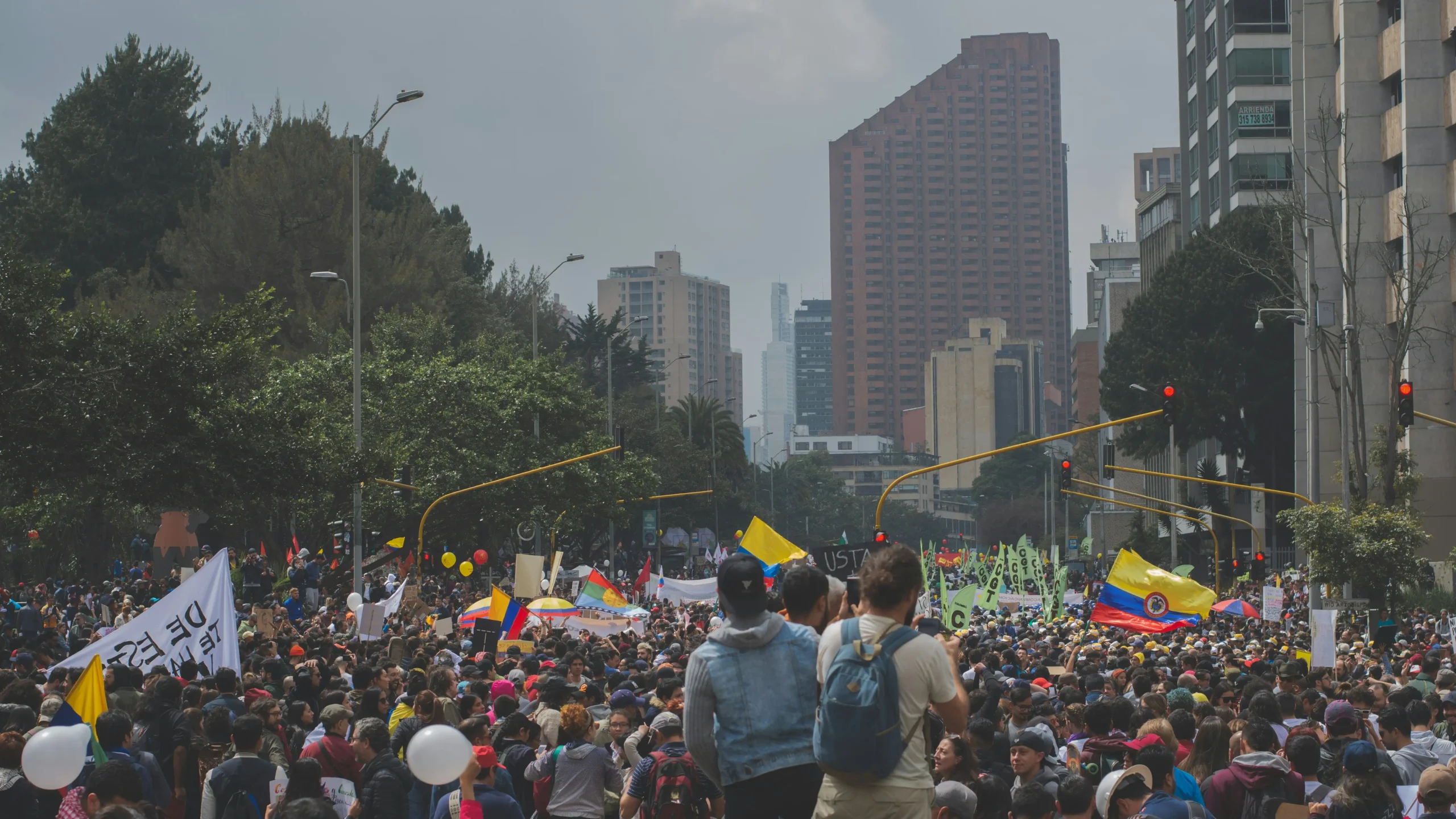
Everything moves too fast. Every new outrage is designed to bury the previous one. Algorithms reward fanaticism and scandal. Politics became a giant emotional performance where almost nobody listens and everybody reacts. You only need to look at any crowd — left, right, government or opposition — to realize that the country itself seems trapped inside a conversation where everyone is shouting and almost nobody is thinking.
We are living inside a permanent fire.
A fire of anger.
Of propaganda.
Of resentment.
And when a society remains in that state for too long, it begins to trust anyone who promises to extinguish the flames.
That is where many mistakes begin.
Fear reduces the ability to think clearly. Tense societies rarely make wise decisions.
That is why these elections feel different. Not because of the candidates or the ideologies, but because something heavier has accumulated in the atmosphere. As if the entire country were walking around a bomb without knowing exactly who activated the timer.
Maybe the bomb is not a government.
Maybe it is this permanent state of division, manipulation and emotional exhaustion.
Corruption helped build that mindset. Not only because it stole money, but because it eroded trust. Institutions became suspicious. Politicians became suspicious. Business leaders, media outlets, even good intentions became suspicious.
And little by little, society begins to operate on reflex.
The crowds emerge. People voting from rage or exhaustion. People surrendering their own judgment to algorithms, fanaticism or the same old political machinery.
That is what feels unsettling about this moment.
While we remain trapped in that noise, the world is changing beneath our feet. Artificial intelligence is accelerating entire industries. Data centers are beginning to consume enormous amounts of energy. Global competition is no longer only political or military; it is also about electricity, water, minerals, infrastructure and technological capacity.
In the middle of that transformation, nature itself has acquired a different weight. Forests are no longer just scenery. Water no longer feels infinite. Carbon, energy and biodiversity are becoming strategic assets tied to power, stability and survival.
And Colombia still possesses much of that.
A country that is creative, violent and strategic at the same time. A country that still holds water, biodiversity, energy potential, culture and talent.
But no natural resource is enough when a society stops thinking, creating and imagining the future.
That is the risk.
Not only making the wrong political choice, but wasting a historical moment while the world enters a new era in which Colombia could actually matter.
Because sustainability is not a moral luxury or a corporate slogan. It has to do with permanence, realism and long-term vision. It means understanding that no meaningful growth can emerge from a destroyed territory, a fractured society and a democracy trapped inside emotional manipulation.
Energy matters. Nature matters. Culture matters. Creativity matters. Everything is connected.
Music, books, films and stories sustain something that is often underestimated: a society’s ability not to become entirely consumed by rage.
Even in its darkest moments, Colombia never stopped producing beauty. In the middle of bombings, a song would appear. During blackouts, people still found reasons to celebrate. In the middle of uncertainty, art kept emerging.
That is why I still believe Colombia has a way forward.
Not because the danger is not real. It is. And denying it would be naive. It lives inside corruption that destroys trust, public debate transformed into emotional propaganda, and the frightening ease with which millions of people stopped observing and simply started repeating.
That is precisely why these elections demand something unusually difficult in our time: lucidity.
The lucidity to pause for a moment amid the noise. To breathe. To open our eyes. To examine trajectories instead of speeches. To stop swallowing narratives whole. To recover the ability to think independently before surrendering the country to fanaticism, exhaustion or collective inertia.
Because countries do not collapse overnight. They deteriorate when people stop thinking clearly, when they lose the ability to distinguish information from manipulation, and begin acting only through impulse or the reflex of following the crowd.
Perhaps that is the real decision behind these elections.
Not simply choosing a president.
But deciding whether we are still capable of stepping away from the explosion and finally beginning to build something different.