A perspective on energy, development, and why users and local realities belong at the center
By Gerardo Chávez C.
These reflections began after I read “Colombia Does Not Need Another Energy Promise”, an article based on the thesis and perspective Adriana Espinel developed for the Bogotá Chamber of Commerce Energy Cluster.
I share the central idea of her presentation: Colombia must learn to turn energy into development. Juan Daniel Correa’s article set that discussion in motion and led me to approach it from a field I know well: energy services, users, communities, and territories.
Electric energy allows people to cook and study, businesses to produce and preserve food, hospitals to care for patients, and small shops to keep their doors open. It is an essential public service. So the question is not only how much energy we can generate. We must also consider how it reaches people, who participates, what it costs, and whether it improves their lives.
When a public service becomes a business
Colombia has enacted laws and regulations to organize its energy markets and enable public, private, and mixed-ownership companies to meet demand. This economic rationale protects investment, supports operations, and seeks to ensure continuity of supply.
Tension arises when profitability overshadows the system’s basic purpose: providing a reliable, high-quality service at a reasonable price.
Regulation allows penalties for interruptions, deficiencies, and poor service. But if noncompliance costs less than fixing its cause, the incentive is misplaced. Paying a fine may be cheaper for an operator than making the necessary investment.
Regulating rates and penalizing failures is essential, but it is not enough. We should also ask whether the rules truly place users at the center and lead to measurable improvements.
If energy is valued mainly by the margin it generates for its supplier, its ability to support collective development is pushed aside.
New energy sources, the same mindset
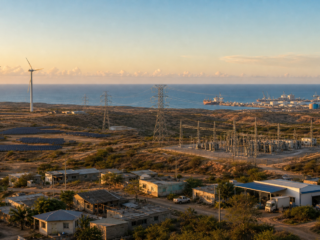
Colombia’s National Interconnected System is the extensive grid that carries electricity from power plants to cities, industries, and homes. It works best where infrastructure already exists and users are numerous. In remote areas, extending poles and power lines costs more while serving fewer customers. For a company, the numbers seldom add up.
Renewable energy offers a different way of thinking because it can harness resources already available in each territory: sunlight, wind, water, biomass, or heat from the Earth. These are natural, practical solutions—without all the bells and whistles.
Yet we still tend to fit renewables into the old model: one company generates the electricity, the power travels through the grid, and another operator delivers it to the user. We replace a large hydropower or thermal plant with solar panels or wind turbines but preserve the same route, intermediaries, and regulations designed primarily for a centralized system.
This is not an argument for abandoning the grid or relaxing technical standards. Laws 142 and 143 of 1994 govern electricity services, while regulations such as RETIE protect the safety of electrical installations.
What can change is how each solution is organized, operated, and managed. A scattered rural community does not function like a city, and a small village does not have the same needs as an industrial district. In some places, extending the grid will be the right answer. Elsewhere, an isolated system, microgrid, or community-managed solution may work better.
The energy transition is not merely about changing where electricity comes from. It also asks us to reconsider how power is produced, who manages it, and how it reaches each territory.
The value of energy independence
Large grids can coexist with individual systems, stand-alone solutions, and community microgrids.
Many industries are already pursuing greater energy independence. Investing in solar, wind, or biomass generation may prove more economical than paying rising rates within a system still vulnerable to service failures and fluctuations in reservoir levels. Sugar mills, cement plants, and other companies have used cogeneration for years to secure part of their supply.
The more interesting question arises when we consider ordinary citizens.
Where electricity is expensive or unreliable, families and small businesses are exploring ways to generate their own power. A household solar system can reduce dependence on a traditional distributor.
The business opportunity shifts. Intermediation decreases, while users gain value through greater independence, continuity, and control. New opportunities emerge for local installers, technicians, operators, and small maintenance companies.
Now imagine that the decision is made not by one household, but by an entire neighborhood, village, or rural community. The investment could be financed through loans repaid in monthly installments similar to the electricity bills residents already pay.
The result would be an organic, practical, and quiet energy transition—without fanfare. It could move forward under existing rules instead of waiting for another decree or grand announcement.
Small solutions are possible. When many of them come together, their impact may be anything but small.
The idea reflects an argument associated with Adam Smith in The Wealth of Nations: by rationally pursuing personal wellbeing, an individual may contribute to the common good without having set out to do so. Put simply, individual wellbeing can generate collective benefits.
Applied to energy, this means that when a family or small business invests in a more reliable and affordable service, the benefits may spread beyond its own doorstep. Many such decisions can create space for local suppliers, employment, and productive activity instead of simply perpetuating payments to a traditional provider.
For that to happen, users need balanced rules, accessible financing, and genuine alternatives.
Palmor: energy built by a community
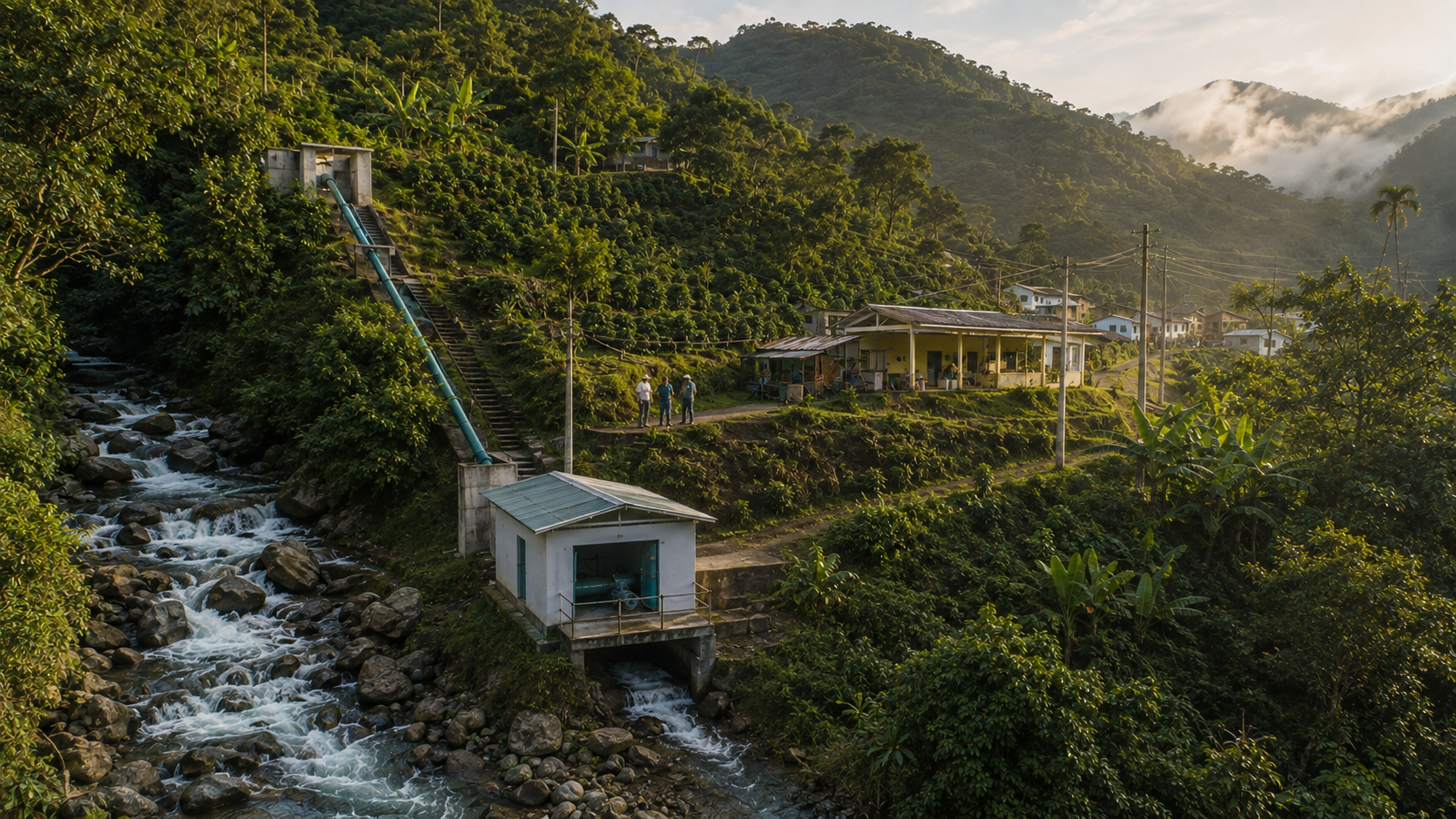
Palmor, in the Sierra Nevada de Santa Marta, shows what this possibility can look like in practice. Since the early 1990s, the community has generated electricity through a small hydropower plant fed by the Cherúa River.
The plant initially supplied 105 homes. As the population and local economy grew, it came to serve roughly 420 users. The community took responsibility for its administration, operation, and maintenance.
I know this story firsthand. Around 2013, when a new expansion phase began to take shape, I participated through USAID’s Colombia Clean Energy Program, known as CCEP, under the leadership of our mentor and teacher José Eddy Torres.
José Eddy knew the territory well. Many years earlier, he had helped lead the development of the original small hydropower plant.
The expansion was carried out between 2014 and 2016 with the participation of CCEP, the Institute for Planning and Promotion of Energy Solutions for Non-Interconnected Zones (IPSE), and Electropalmor. It added a 150-kilowatt generating unit, repaired the existing turbine, and improved the substation, hydraulic and electrical networks, and powerhouse. The technical work also strengthened the community organization responsible for the service.
Palmor is more than an engineering project or a turbine driven by water. It is a community that turned a local resource into electricity, organization, and a shared asset.
Its experience shows that energy can be produced close to where it is consumed and that users can participate in managing it. It also points to the local economies that can grow around installation, operation, and maintenance.
Palmor is not a formula to be copied without regard for context. It is evidence that the conventional system is not the only possibility.
A necessary kind of rebellion
There are other examples. Rural families can use biogas for cooking or small water sources to supply their communities. In Bogotá, neighborhoods such as Niza VIII and Ciudad Salitre have used solar water-heating systems for decades. These are practical solutions that have worked quietly, away from grand announcements.
The energy transition could benefit from a more open and inclusive view—one that pays closer attention to place.
That does not mean discarding everything that already exists. We should preserve what works, examine flawed incentives, and test alternatives responsibly. Innovation is not limited to installing a different technology. It can also reshape the relationships among government, companies, communities, and users.
Perhaps we need a slightly rebellious outlook, in the best sense of the word: one willing to question inertia, test new solutions, and place wellbeing at the center without ignoring economic sustainability.
Paradigm shifts rarely happen on their own. They require decisions, experimentation, and a willingness to take risks.
Turning energy into development invites us to rethink how we produce, distribute, and use it. No single answer will work equally well for every region, community, and person.
Technology, financing, and regulation will need to support that process.
But perhaps the first step is changing the way we think.
About the author
Gerardo Chávez C. is a business administrator with more than forty years of experience in consulting, economic research, market studies, and information systems. He specializes in statistical methodologies and field research on energy use in rural areas and productive sectors. He has worked with public and private institutions in the energy, environmental, and market sectors. As part of USAID’s Colombia Clean Energy Program, he contributed to the design, implementation, and territorial coordination of Colombia’s Rural Electrification Plans (PERS).
Sources
- Adam Smith, The Wealth of Nations, Book IV, Chapter II.
- USAID–CCEP, Final Report of the Colombia Clean Energy Program.
- Electropalmor, history of the small hydropower plant and its community management.
- El Espectador, “El pueblo que genera su propia luz”.
- Portafolio, “Gobierno les apuesta a las microcentrales hidroeléctricas”.