
By Juan Daniel Correa Salazar
In collaboration with BNamericas
This May 14, Guatemala will host the first edition of Future Energy Summit (FES) Central America & Caribbean. The timing is not accidental.
As renewable investments accelerate across the region, Central America is beginning to face mounting pressure on its electrical infrastructure. The discussion is no longer centered only on adding generation capacity. Increasingly, the focus is shifting toward transmission, grid stability and regional integration between national power systems.
In that context, Guatemala is emerging as one of the most active energy nodes in Central America.
The recent approval of the PEG-5-2025 auction results confirmed a significant signal: nearly 70% of the awarded contracts went to renewable energy projects, primarily solar. Among other developments, Grupo Dragón is advancing three solar-plus-storage projects totaling 120 MW of photovoltaic capacity and 192 MWh of battery storage, with investments estimated at US$150 million. At the same time, Transnova —linked to Grupo Energía Bogotá (GEB)— is seeking US$65 million to strengthen transmission infrastructure and substations in Guatemala amid growing pressure on regional power exchange capacity.
But the main source of tension is beginning to emerge elsewhere: the grid itself.
The SIEPAC system —the backbone of Central America’s regional electricity interconnection— is entering an expansion phase estimated at nearly US$470 million, according to the Regional Operating Entity (EOR). The immediate goal is to maintain and expand cross-border transmission capacity, which is increasingly constrained by rising renewable generation and electricity demand across the region.
This is no longer just a technical conversation. It is becoming a question of regional capacity.
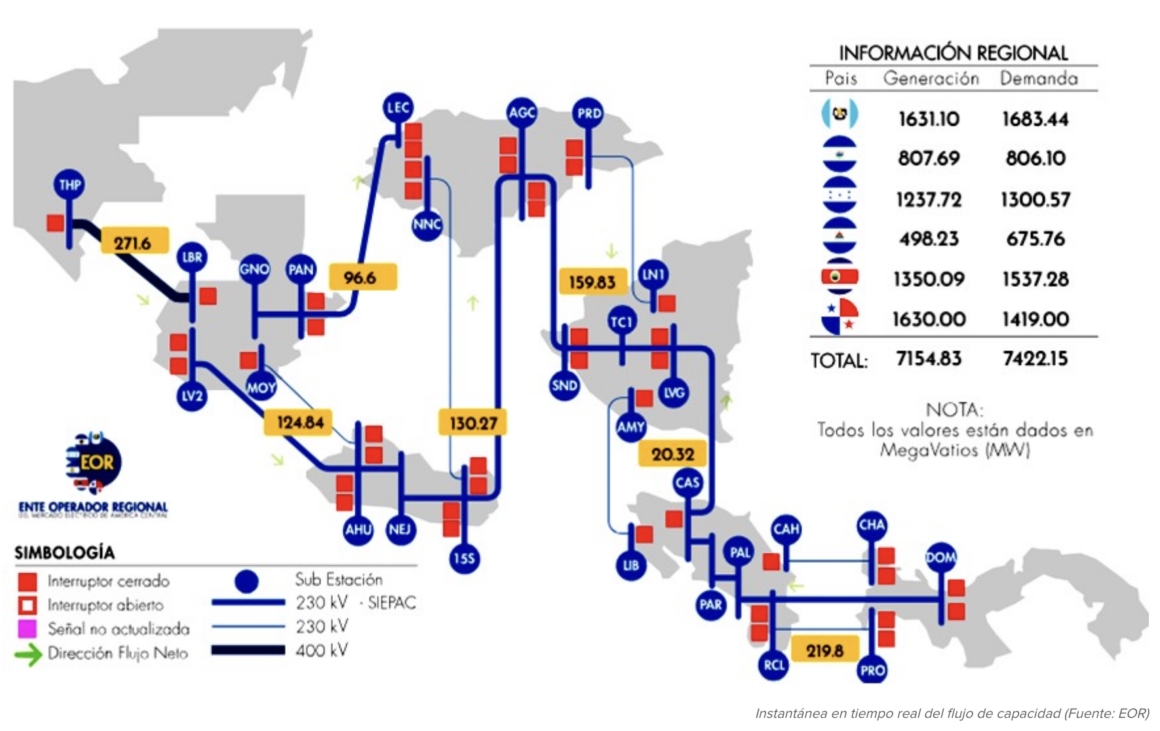
The scale of that challenge is reflected in the day-to-day operation of the SIEPAC network. The map below, published by the EOR, illustrates how Central America is already functioning as an interconnected electrical system, with continuous cross-border energy flows and uneven balances between generation and demand across countries.
The blue lines represent the regional transmission infrastructure, while the yellow indicators show real-time electricity exchanges between national systems. Together, they help explain why transmission expansion has become a strategic priority for the region.
The underlying signal is becoming increasingly difficult to ignore: Central America is entering a phase where the energy transition will no longer depend only on adding new renewable megawatts.
The pace of regional expansion will also be measured by the ability to move electricity across borders, maintain grid stability and coordinate increasingly interconnected power systems.
Guatemala now sits at the center of that movement.
At Clean Energy, we follow these regional shifts not simply as sector coverage, but as part of a broader transformation in Latin American energy infrastructure — one in which the grid itself is becoming as important as generation.
Sources and references
- BNamericas — Central America’s power grid expansion estimated at US$470mn
- BNamericas — Guatemala approves winners of PEG-5 energy auction
- BNamericas — Grupo Dragón awarded three solar projects in Guatemala’s largest power tender
- BNamericas — Grupo Energía Bogotá unit seeks US$65mn for Guatemala operations
- Regional Operating Entity (EOR) — Central American Electrical Interconnection System (SIEPAC)