
El Niño is here, and Colombia is once again considering turning its clocks forward. The measure may be sensible. What would be indefensible is selling sixty minutes of daylight as energy policy.
By Juan Daniel Correa Salazar, in collaboration with BNamericas
At midnight on May 2, 1992, Colombia lost an hour.
After 11:59 p.m. came 1:00 a.m. The country moved its clocks forward to make better use of daylight and reduce electricity consumption in the early evening.
The measure entered history as Hora Gaviria—Gaviria Time—after César Gaviria, Colombia’s president at the time.
Electricity rationing had already lasted two months. Bogotá endured outages of up to nine hours a day; in San Andrés and Providencia, they stretched to eighteen. Families returned to candlelight, and radio kept them company through the night. La Luciérnaga—The Firefly—was created to cast some humor into the blackout and outlived the crisis that gave it birth.
El Niño had reduced rainfall and drained the reservoirs. But the climate did not act alone. The drought found a power system too dependent on water, delayed infrastructure and a government that grasped the severity of the crisis only after darkness had entered people’s homes.
Colombia moved the clock because it could no longer move enough electricity.
Thirty-four years later, the country is considering the same measure.
How are we here again?
El Niño is present and strengthening. The US National Oceanic and Atmospheric Administration estimates a 97% probability that it will persist through the first months of 2027 and an 81% chance that it will reach very strong intensity between October and December this year. Colombia’s Institute of Hydrology, Meteorology and Environmental Studies, IDEAM, expects below-normal rainfall across several regions during the second half of 2026.
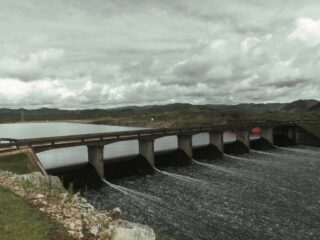
Sociedad Hidroituango, backed by the government of Antioquia, has proposed moving the country’s legal time forward once again to ease evening demand and preserve water in the reservoirs.
The idea makes sense. Millions of households switch on lights and appliances just as solar generation disappears. Shifting part of that demand would make better use of late-afternoon daylight and reduce pressure on the grid.
There is a real possibility that Colombia will change its clocks again.
Some are already calling it La Hora del Tigre—the Tiger’s Hour.
It may be coming.
What is scandalous is not considering the measure. What is scandalous is that, more than three decades later, we may still need it.
Colombia had time to diversify its power mix, expand transmission, secure firm energy, develop storage and put its gas policy in order.
Seven presidents. Dozens of ministers. Plans, laws, commissions, auctions and historic announcements.
And here we are: watching the sky, calculating how much water remains in the reservoirs and wondering whether we will have to wake an hour earlier to keep the country from going dark.
At some point, Colombia must stop calling recurrent events unpredictable.
The country did learn from the 1992 rationing crisis. It reformed the electricity sector, strengthened its institutions and expanded generation capacity. Today, its power system is more robust, its technical capabilities are greater and its tools for anticipating risk are better.
What is unsettling is that, despite everything learned and built, the same signs of fragility are reappearing as darkness threatens once more.
There has been progress. Colombia created rules for non-conventional energy sources, held renewable auctions and opened the door to new technologies.
An old habit survived as well: confusing energy policy with energy announcements.
Colombia celebrates contracted megawatts as though they were already generating electricity. Projects are presented as realities before they have financing, permits, grid connections or agreements with local communities.
The ceremony still tends to precede the work.
Gustavo Petro’s government deserves particular scrutiny because no administration spoke more insistently about the energy transition.
It would be unfair to ignore its achievements. By the end of March 2026, solar accounted for 8.7% of the system’s net effective capacity. A source that had been marginal until recently was approaching one-tenth of the total. Energy communities also advanced, as did regulation for geothermal power and storage.
But a transition is not completed by installing panels or adding megawatts. That electricity must be connected, transmitted, stored and backed up when the sun disappears.
That is where execution fell short.
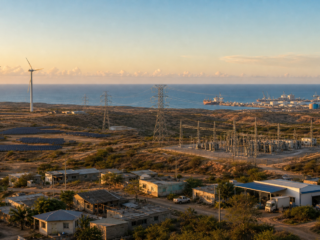
Transmission remained behind schedule. Wind projects in La Guajira stayed trapped among delays, conflict and a weak state presence. Declining gas self-sufficiency increased Colombia’s exposure to imports. The government spoke of exporting clean electricity while the country still lacked the networks required to move it across its own territory.
Beneath those shortcomings lay a deeper failure: corruption.
The scandal at Colombia’s National Unit for Disaster Risk Management exposed one of corruption’s most infuriating forms: turning human need into a business opportunity. It came to light through the irregular purchase of 40 tanker trucks intended to carry water to thirsty communities in La Guajira, and eventually revealed a web of inflated prices, bribes and political favors reaching senior government officials and congressional leaders.
While the water struggled to arrive, the money found its way.
The agency created to respond to disasters ended up manufacturing one.
Corruption does more than divert public funds. It delays projects, destroys trust and weakens the institutions Colombia needs most when the climate puts its energy system to the test.
Petro was right to place the energy transition at the center of the national agenda. His mistake was to portray it as more advanced than the infrastructure justified—and to manage it through institutions that lost credibility.
A transition is not measured by how many times a president says the words. It is measured in clean energy produced, connected, stored and available when the country needs it.
By that standard, the distance between the reach of the rhetoric, the strength of the results and the integrity required for genuine transformation remains far too wide.
Yet it would be convenient to place all responsibility on the presidential palace. An energy system is also built—or obstructed—by companies, territories, communities, universities, the media and citizens’ everyday choices.
In Colombia, popular wisdom says that everyone has “a candle at this funeral.”
Rarely has the expression been so literal.
In 1931, ninety-five years ago, Salvador Dalí painted The Persistence of Memory.
In its barren landscape, clocks have lost their rigidity. They bend and collapse, seemingly incapable of keeping time in order.
Colombia is approaching a disturbingly similar scene. Climate, political power and infrastructure are moving at different speeds, as though each obeyed a melting clock of its own.
We can move the hands.
What we cannot keep distorting is our memory.
The climate clock is already ticking. The Pacific Ocean will not wait for a presidential inauguration.
The political clock begins on August 7. There will be announcements, decrees and promises of speed. But energy does not understand presidential calendars: a decision signed in the morning cannot produce gas that same afternoon.
The third clock belongs to infrastructure. It is the slowest—and the only one capable of keeping the country running.
Sirius, the largest gas discovery in Colombia’s history, lies in the deep waters of the Caribbean and is being developed by Ecopetrol and Petrobras. Production could begin in 2029 or 2030: too late to ease the immediate pressure, but soon enough to remind us that strategic decisions can no longer be delayed.
Colectora, the transmission line designed to carry renewable electricity from La Guajira, has accumulated years of delays amid prior-consultation processes, environmental permitting and pending agreements with communities along its route. Geothermal power requires patient exploration. Batteries require rules, capital and deployment.
Climate moves in months.
Power moves in headlines.
Infrastructure moves in years.
And all three clocks are about to strike the same hour.
It would be irresponsible to declare that rationing is inevitable. Dismissing the warnings would be worse.
Analyses reported by BNamericas point to potential firm-energy deficits of 2.3% in 2026 and 4.4% in 2027. These are scenarios, not prophecies. The outcome will depend on rainfall, demand, plant availability, fuel supply and the timely delivery of new projects.
But the conditions behind those scenarios are real.
XM, Colombia’s power market and system operator, expects electricity demand to grow by roughly 2.9% in 2026 and 3% in 2027. The country enters this El Niño with less gas self-sufficiency, greater exposure to imports and power companies under financial strain.
By July 10, outstanding receivables in the wholesale electricity market were estimated at COP3.4 trillion. That pressure is compounded by the crisis at utility Air-e and uncertainty over the continuity of service in the Caribbean region.
A power system begins to shut down long before a home goes dark: when one company stops paying, a thermal generator cannot secure fuel, maintenance is postponed or a transmission line remains stalled.
Physical darkness is only the final scene.
First comes the financial, regulatory and institutional blackout.
Darkness, however, does more than conceal.
It also reveals.
When water levels fall in the reservoirs, unfinished infrastructure and postponed decisions come into view. Excuses lose their volume. What matters begins to take shape.
In Soda Stereo’s Crema de estrellas, Gustavo Cerati sang: “When everything is dark, things begin to look clearer.”
He was not singing about reservoirs or power lines. Yet few images describe this moment more precisely. Sometimes the glow of rhetoric must fade before we can recognize the constellation that was always in front of us.
Colombia is not starting from nothing.
It has capable companies, universities, scientists, engineers, accumulated knowledge and one of the cleanest electricity systems in the region. It has sunlight, wind, water, biomass, gas and a mountain range that stores heat beneath the earth.
Energy itself is not what Colombia lacks.
What it has failed to do is turn resources into projects—and projects into a system.
Abelardo de la Espriella will inherit a system under pressure, but also an exceptional opportunity: to make an emergency the beginning of genuine transformation.
Colombia must restore confidence, unblock projects and secure the gas required to support its power system. Renewed exploration can strengthen medium- and long-term energy security, but it cannot resolve the immediate pressure. Years separate the award of an exploration block, a commercial discovery and the start of production.
The transition demands that Colombia manage the present without mortgaging the future: combining environmental ambition, technical rigor and economic viability, while turning into infrastructure what has remained trapped between rhetoric and reality.
Solar power provides low-emission electricity, but it is not available around the clock. Gas can support the system when daylight fades without becoming an excuse to postpone the transition.
Colombia must integrate renewables and firm generation into a more diverse, reliable and cleaner mix: harnessing the light without becoming defenseless when night falls.
Using every kilowatt more wisely matters just as much. Well-designed buildings, efficient equipment, modernized industries, smart metering and demand management can free capacity sooner than a new power plant. Energy efficiency should not be reduced to asking families to switch off a light bulb. It is a policy of productivity and competitiveness.
Adding more solar and wind requires modern grids, batteries, backup and flexible markets. Megawatts drawn on a presentation slide still cannot light a home.
Clean energy is not whatever looks best in a photograph. It is energy that reduces emissions without sacrificing reliability; that can attract financing, reach communities and perform when the system is under strain.
An energy policy riddled with corruption, improvisation or technical falsehood does not deserve to be called clean either. Those failures do not appear in emissions inventories, but they leave another kind of footprint: wasted resources, stalled projects and institutions stripped of credibility.
The Tiger will have to govern something far more difficult than a campaign: a system bound by the laws of physics, the pace of infrastructure and the pressure of the climate.
Electrons do not recognize ideologies. Reservoirs do not respond to slogans. A roar may be a good beginning—even a battle cry. Then it must become projects, grids and kilowatts.
We trust that the new government will act in time. We will be here to support what works, contribute to solutions and call out any attempt to present cosmetic change as transformation.
But we cannot expect the government to turn on every light.
Companies will have to invest. Territories must participate and receive tangible benefits. Universities must conduct research and educate. Banks must finance new technologies. The media must report with rigor. Citizens must demand more and consume better.
The energy transition will be a collective undertaking—or end like so many promises, dissolved in an ocean of announcements.
Built properly, it can deliver reliable electricity to underserved territories, attract industry, reduce costs and create jobs. It can turn a rooftop into a source of power, help a factory waste less, allow a battery to hold the afternoon sun and carry the wind of La Guajira across the country without leaving behind the people who inhabit that land.
That possibility is real.
Lights are already shining across Colombia—in its territories, its knowledge and its people.
What remains is to make them illuminate the same path.
Moving the clocks forward may help. The measure should be assessed rigorously and adopted if it reduces demand and preserves water in the reservoirs. But it would be only one precaution within a much larger strategy.
Colombia faces an enormous risk—and an opportunity of equal scale.
We can return to candlelight while waiting for rain. Or we can build a system capable of crossing the drought without kneeling before the sky.
What would be indefensible is selling sixty minutes as though they were thirty-four years of solutions.
On August 7, the president, the ministers and the language of power will change.
The ocean will not notice.
The reservoirs will continue to obey the rain. The turbines, water and gas. The grids, the laws of physics.
The Tiger may change the clock.
Changing history will take all of us.
In 1992, darkness forced Colombia to move the hands.
In 2026, it may force us to move the country.
Perhaps that is the light hidden inside the threat: the realization that Colombia is not condemned to repeat the blackout. It has what it takes to write a different ending.
That ending must begin now.
Because there is one hour the country can no longer postpone:
The hour of clean energy.
Sources consulted
BNamericas: 2026 analysis and reporting on energy security, gas, geothermal power, transmission, storage and renewable expansion in Colombia; NOAA Climate Prediction Center; IDEAM; XM; UPME; CREG; Decree 717 of 1992; Señal Memoria; El Colombiano; Caracol Radio; El País; Museum of Modern Art, Salvador Dalí, The Persistence of Memory (1931); Soda Stereo, Crema de estrellas, Sueño Stereo (1995).